
Five million factory robots: what it takes to put one on a GMP line
The request arrives as a one-page business case. The end of a vial line still has two operators loading trays by hand, eight hours a shift, and the site wants a robot there before the next product launch. The robot supplier has a demonstration video, a price and a delivery date. Then three people read the business case. Quality asks which user requirements the robot will be qualified against. Health and safety asks whether it is a collaborative robot. The OT security lead asks who will log in to the teach pendant, and from where.
None of those questions is about the robot’s arm, and all three decide whether the project lands on time. This article takes the new world robot statistics as a starting point and sets out what a regulated plant has to add around the machine: what the safety standards cover and leave out, what EU GMP expects, and why the robot program belongs under change control.
Five million robots, and what the count says
The International Federation of Robotics (IFR) published its World Robotics 2026 figures on 24 September 2026. The operational stock of industrial robots rose 9% in 2025 to a record 5 million units, and factories installed more than 600,000 new robots over the year, an 11% increase. The IFR notes that the stock is more than double the figure of seven years earlier.
Growth is uneven. China installed 354,000 robots in 2025, 59% of the world total. The United States grew 12% to almost 38,500 units and overtook Japan as the second market. Germany, still the largest market in Europe, fell 8% to fewer than 25,000 units. The IFR forecasts 655,000 installations in 2026 and 806,000 in 2029.
Robot density, the number of operational robots per 10,000 manufacturing employees, says more about how automated a country’s factories are. In the IFR’s previous edition, covering 2024, the global average was 132, the European Union 231, Germany 449 and the Republic of Korea 1,220. The IFR’s press releases do not single out pharmaceuticals, and we will not invent a figure for them. What the numbers do show is that robots have become ordinary capital equipment, sold by many vendors and installed by integrators who have done hundreds of cells. On a GMP site the robot is rarely the hard part. The hard part is everything the site must prove around it.
Where a robot enters a pharmaceutical plant
Most requests land in one of four places, and each starts from a different question.
| Place | Typical task | What GMP asks first | What the safety standard says |
|---|---|---|---|
| Secondary packaging and palletising | Case packing, tray loading, pallet building | Line clearance, mix-up prevention, the packaging record | Core scope of ISO 10218-2: a robot application in a cell |
| Aseptic processing | Loading lyophilisers, handling inside an isolator, removing operator interventions | Contamination control strategy, cleanability, decontamination agent compatibility | Hygienic requirements are outside ISO 10218: they belong in your URS |
| Quality control laboratory | Sample preparation, plate handling, feeding analysers | Data integrity of the analytical record, audit trail | ISO 10218-2 states that laboratory automation is not a medical application |
| Warehouse and intralogistics | Mobile robots between stores and lines | Status of materials, segregation of quarantine stock | Mobility on driverless trucks or mobile platforms is outside ISO 10218 |
What the safety standard covers, and what it leaves to you
ISO 10218 was revised in 2025, its first new edition since 2011. Part 1 sets the requirements for the robot itself and is addressed to the manufacturer. Part 2 covers industrial robot applications and robot cells and is addressed to the integrator, from design and commissioning through operation and maintenance to decommissioning. Three changes matter on a pharmaceutical site.
First, collaborative is now a property of the application. The requirements for collaborative operation that used to sit in the technical specification ISO/TS 15066:2016 have moved into the ISO 10218 series, and the terms “collaborative robot” and “collaborative operation” are gone. The standard speaks of a collaborative application, because only the actual use, with its tool, its part and its speed, can be designed, tested and confirmed as collaborative. A cobot on a data sheet does not make a collaborative cell on your line.
Second, cybersecurity has entered the safety standard. The 2025 editions add cybersecurity requirements, limited to what can affect robot safety. They do not replace an OT security programme, but they spell out the link: a safety function that can be switched off over the network has to be treated as a safety problem.
Third, hygiene and product are explicitly out. The scope of ISO 10218-2:2025 excludes hazards related to “use that has hygienic requirements” and to the “processing of any material (e.g. food, cosmetics, pharmaceutical, metal)”. The standard protects the operator. Nobody in it is protecting the batch.
For a pharmaceutical site that exclusion is the most useful sentence in the standard. Surface finish, cleanability, resistance to hydrogen peroxide vapour, particle generation, lubricants, materials in contact with product: no robot safety certificate says anything about them. They go into the user requirements specification, or they do not get tested.
The legal frame is changing as well. The EU Machinery Regulation (EU) 2023/1230 applies from 20 January 2027, the date as corrected in the Official Journal of 4 July 2023. Two of its essential requirements concern a networked robot cell directly. Annex III §1.1.9, protection against corruption, requires that the connection of another device, including a remote one, “does not lead to a hazardous situation”. Annex III §1.2.1(a) requires control systems to withstand “reasonably foreseeable malicious attempts from third parties leading to a hazardous situation”. The wider argument is in cybersecurity is now part of functional safety.
What EU GMP expects from the robot
Annex 1, in operation since 25 August 2023, is the only EU GMP text that names robots. Its principle, §2.1(i), lists “robotic systems” among the technologies that “should be considered to increase the protection of the product” from contamination by personnel, materials and the environment. Section 8.9 goes further: “Robotics and automation of processes can also be considered to eliminate direct human critical interventions”, with automated lyophiliser loading as the example.
Read the wording closely. Annex 1 treats the robot as a contamination control measure, so it has to appear in the site’s contamination control strategy with the risk it removes and the risks it brings. A robot arm inside a grade A zone is also a surface to decontaminate, a source of particles once its joints wear, and a new kind of intervention on the day it faults and someone has to reach in.
The rest follows the ordinary qualification path. Annex 15 §3.2 asks for a user requirements specification in which “the essential elements of quality need to be built in” and GMP risks mitigated, and which remains the reference throughout the validation life cycle. §3.3 asks the design qualification to verify the URS. How to write that document is covered in writing a URS that actually drives the qualification.
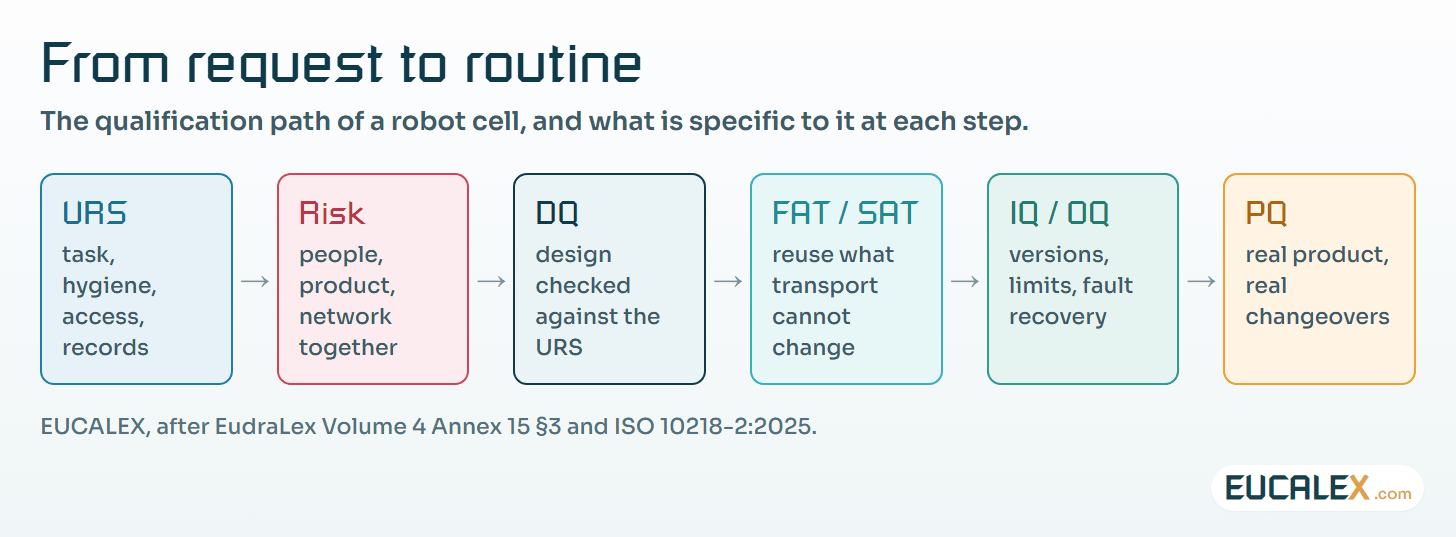
A robot controller is a computerised system, so Annex 11 applies too. §1 asks for risk management across the life cycle, with the extent of validation based on a documented risk assessment. §10 requires that changes, “including system configurations”, are made only in a controlled manner. §12 requires physical or logical controls that restrict access to authorised persons. On a robot cell each of these has a very concrete meaning, starting with the program.
The robot program is a GMP record
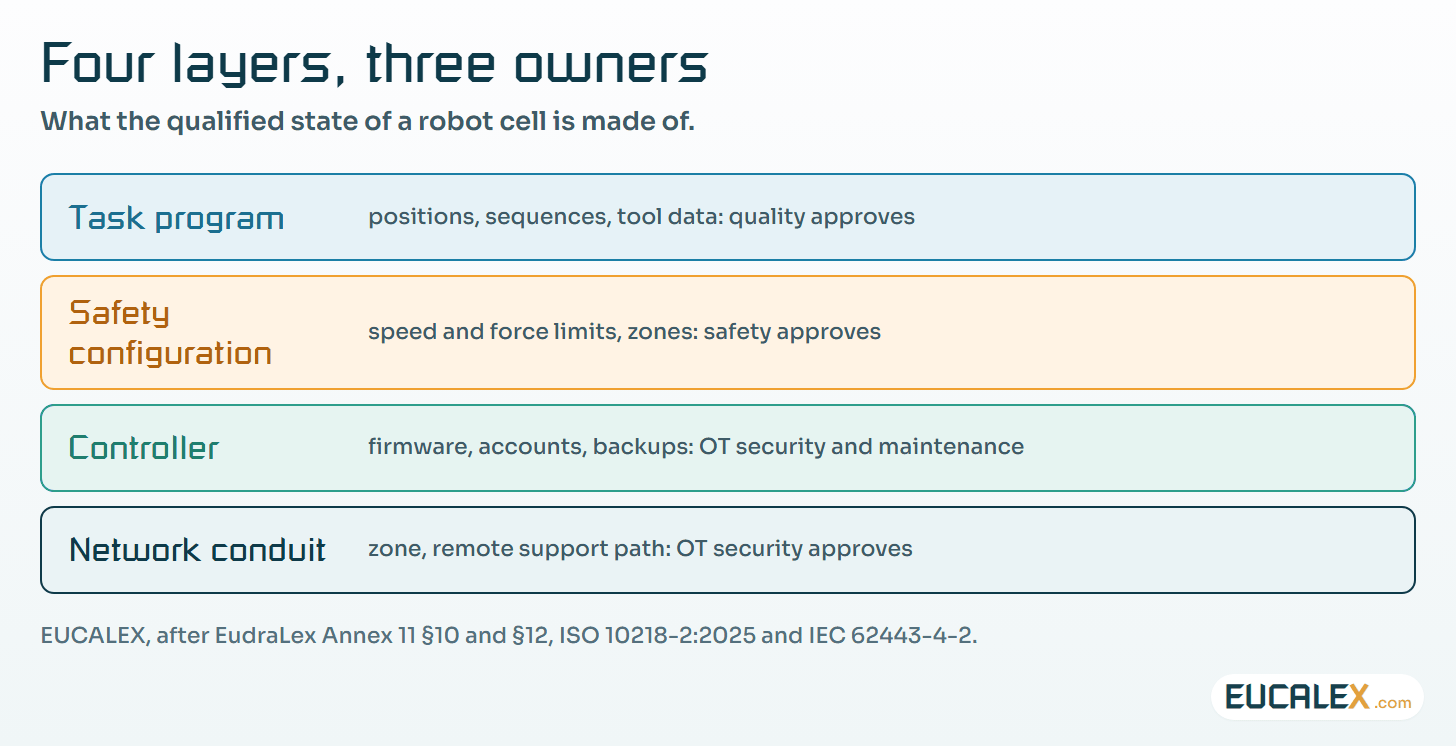
On most lines the qualified state of a robot cell lives in a handful of files: the task program, the taught positions, the tool and payload data, the speed and force limits, and the safety configuration. They are small, easy to copy and easy to change from the pendant, which is exactly why someone has to own them.
Take the usual night-shift scene. The gripper clips a tray guide, the cell stops, and the technician on call re-teaches three positions to get the line running again. The product is the same; the path is not. Whether that needs retesting is a change control decision, not a maintenance habit, and when a repair becomes a requalification explains how to make it quickly.
The program version also belongs in the record. If the robot placed the vials, the version of the program that placed them is part of what happened to the batch.
- Safety and process settings have different owners. Force and speed limits for a collaborative application are signed off by health and safety; positions and sequences by quality. Both are configuration, and a change to either must be visible to the other.
- An unrestored backup proves nothing. Keep a copy of the controller configuration outside the controller, and restore it once, on the spare or during a shutdown, before the day you need it.
The controller is on the OT network
A modern robot controller is an industrial computer with an operating system, user accounts, a network interface, often a USB port and a remote support option. It is an OT asset in the same way as a PLC, and it should be handled as one: in the asset inventory, in a security zone, reached through a controlled conduit.
The purchasing specification is the time to ask for this. IEC 62443-4-2 sets the technical security requirements for industrial automation and control system components, and a robot controller is such a component. Ask the supplier which requirements the controller meets, how firmware is signed and updated, how accounts are managed, and how remote support sessions are opened and recorded. From January 2027, a machine placed on the EU market must also, under Annex III §1.1.9, collect evidence of legitimate or illegitimate intervention in the software critical to its safety.
Eight lines for the URS
- The task and its rate, with the worst-case format and the changeover you actually run.
- The collaborative question answered for the application, not the robot: which tasks share space with people, and which safeguarding the integrator will validate.
- Hygienic design: surface finish, cleanability, the cleaning and decontamination agents used on site, and particle emission where the robot works in a graded zone.
- Materials and lubricants that may contact the product or the zone, with their documentation.
- Configuration management: program versions identified, a change log on the controller, export of the configuration, and a safety configuration that can be compared against its approved copy.
- Access control: named accounts or role-based access on the pendant, no shared default password, and an audit trail of changes where the controller offers one.
- Network and remote support: the security zone, the conduit, the remote access method approved by the site, and the IEC 62443-4-2 capabilities the controller provides.
- Records and interfaces: what the robot reports to the line controller, the manufacturing execution system or the batch record, and in which format.
Where to start
Write the URS before the supplier’s demonstration. A robot seen running on someone else’s product anchors the discussion on speed; your URS should anchor it on the product, the zone and the record.
Then put health and safety, quality and OT security in the same review of the risk assessment. The integrator’s ISO 10218-2 risk assessment covers people. Your GMP risk assessment covers the product and the data. Neither covers the network unless someone puts it there. Before the factory acceptance test, decide which of the supplier’s tests you will reuse and which you must repeat on site.
Five common mistakes
- Buying a cobot and calling the cell collaborative. The 2025 standard no longer lets the word describe the robot. The application is assessed, with its tool, its speed and its part.
- Reading the safety certificate as a hygiene claim. ISO 10218 excludes hygienic requirements and the processing of pharmaceutical material. Cleanability is yours to specify and test.
- Leaving the program outside change control. A re-teach after a crash changes the process. If nobody records it, the qualified state exists only on paper.
- Forgetting the new intervention. The robot removes routine interventions and creates fault recovery. In a grade A zone that recovery has to be designed, trained and simulated like any other intervention.
- Connecting the controller for remote support on day one. The supplier’s modem or cloud agent goes in during commissioning and stays for ten years. Settle the remote access method in the URS, well before the site acceptance test.
The robot is the part of the project that is already solved. What a GMP site has to engineer is the specification around it, the record it leaves and the network it joins.
References
- International Federation of Robotics, Five Million Robots now Operate in Factories Globally, 24 September 2026, and Robot density surges in Europe, Asia and Americas, 8 April 2026.
- ISO, ISO 10218-2:2025, Robotics, safety requirements, Part 2: Industrial robot applications and robot cells, with the A3 answers to frequently asked questions on the revision, 20 March 2025.
- Regulation (EU) 2023/1230 on machinery, Annex III §1.1.9 and §1.2.1, as corrected in the OJ of 4 July 2023).
- European Commission, EudraLex Volume 4, Annex 1 §2.1 and §8.9, Annex 15 §3.2 and §3.3, Annex 11 §1, §10 and §12.
- Automation.com, Five Million Robots now Operate in Factories Globally, 24 September 2026: the news item that prompted this article.
Related articles
All articles- Writing a URS that actually drives the qualification, and deciding whether you need a DQA user requirements specification is either the root of every test that follows or a wish list nobody can test. How to write it one line at a time…
- When does a repair become a requalification? Change control on qualified equipmentA qualification report describes a machine on the day it was signed. Every repair, spare part and program edit after that day either keeps the…
- Cybersecurity is now part of functional safetyA relief valve has no password. A safety PLC does. Once a computer holds the safety limit, security stops being an IT topic.
EUCALEX
Have a project or a technical challenge?
Contact us: we will be pleased to discuss it with you, with no commitment.
Discuss your project with usStay informed
Receive new EUCALEX articles and technical insights by email.