
Technology transfer without retyping: how a process reaches the master recipe, and where it breaks
The first engineering batch at a receiving site is meant to be uneventful. The operators follow the electronic master recipe step by step: charge the granulator, dry mix, add the binder, wet mass. The impeller speed on the screen matches the development report exactly; the recipe author checked it twice. It came from the transfer spreadsheet, which came from the report, which came from a development bowl a fraction of the size of the commercial machine.
Nothing alarms. The granule simply comes out denser than every development batch, and the dissolution results sit closer to the limit than anyone likes. Two days and a long call with the development team later, the answer is embarrassingly simple. Development had really fixed a tip speed, a property of the process. What reached the recipe was a speed in revolutions per minute, a property of one machine. The value was copied faithfully at every step. Its meaning was lost at the first one.
In a December 2022 InTech feature, a life sciences executive at Emerson argued that this handoff between development and manufacturing is the slowest part of the pipeline, because each group keeps its own tools, spreadsheets and scale, and data is re-entered at every stage. Her remedy was process and knowledge management software that pushes recipe parameters straight to the MES. The diagnosis is sound. The remedy is a product, and the figure that came with it (time to market cut from ten years to fewer than three, credited to unnamed experts) is the vendor’s, with no source we could find. This article stays with the diagnosis: what moves, what the texts ask, where it breaks, and how to check it.
What moves is knowledge, not a folder
ICH Q10, which reached Step 4 on 4 June 2008, treats technology transfer as a lifecycle stage of its own. Its goal is ‘to transfer product and process knowledge between development and manufacturing, and within or between manufacturing sites to achieve product realisation’, and that knowledge ‘forms the basis for the manufacturing process, control strategy, process validation approach and ongoing continual improvement’ (§3.1.2).
The WHO guideline, rewritten in 2022 as Annex 4 of Technical Report Series No. 1044, frames every transfer between a sending unit and a receiving unit and sets the bar plainly: ‘documented evidence that the RU can routinely reproduce the transferred product, process or procedure against a predefined set of specifications’ (§1.7). Its Appendix 1 lists the documents commonly required, from development and scale-up reports to hold time studies. A transfer can deliver every one of them and still lose the one fact that mattered.
On the plant side, EU GMP Chapter 4 asks for approved, written processing instructions for each product and batch size, including the sequence for adding materials and the critical process parameters (§4.17 and §4.18). On most modern lines, those instructions are the master recipe. Annex 15 adds that ‘process knowledge from development studies or other sources should be accessible to the manufacturing site, unless otherwise justified, and be the basis for validation activities’ (§5.10). Accessible is the word that matters. A report locked in the sending unit’s document system, which the receiving site’s automation engineer has never opened, does not meet it.
| Text | What it asks | What it means for the recipe |
|---|---|---|
| ICH Q10 (2008), §3.1.2 | Transfer product and process knowledge | Judge the transfer on what the receiving site understands |
| ICH Q12 (2019), ch. 3 | Identify established conditions; changing one needs a regulatory step | The recipe must know which parameters are established conditions |
| WHO TRS 1044 Annex 4 (2022) | Gap analysis; evidence of routine reproduction | Equipment gaps are where scale-dependent values get caught |
| EU GMP Chapter 4 (2011), §4.17–4.18 | Approved instructions per product and batch size | The master recipe is a GMP document, owned and approved like one |
| EU GMP Annex 15 (2015), §5.10 | Development knowledge accessible to the site | The site can read why each value is what it is |
Four levels of recipe, and where the gap opens
Batch control has had a shared vocabulary for this since the 1990s. ANSI/ISA-88, published internationally as IEC 61512, distinguishes four recipe types. The general recipe describes the process without reference to a site or equipment. The site recipe adapts it to one site. The master recipe accounts for the capabilities of specific equipment and is what production runs. The control recipe is its copy for one batch. Part 3 of the series (IEC 61512-3:2008) deals with the general and site levels, and Part 1 has just been revised: IEC 61512-1:2026, the second edition, was published on 20 February 2026 and replaces the 1997 text.
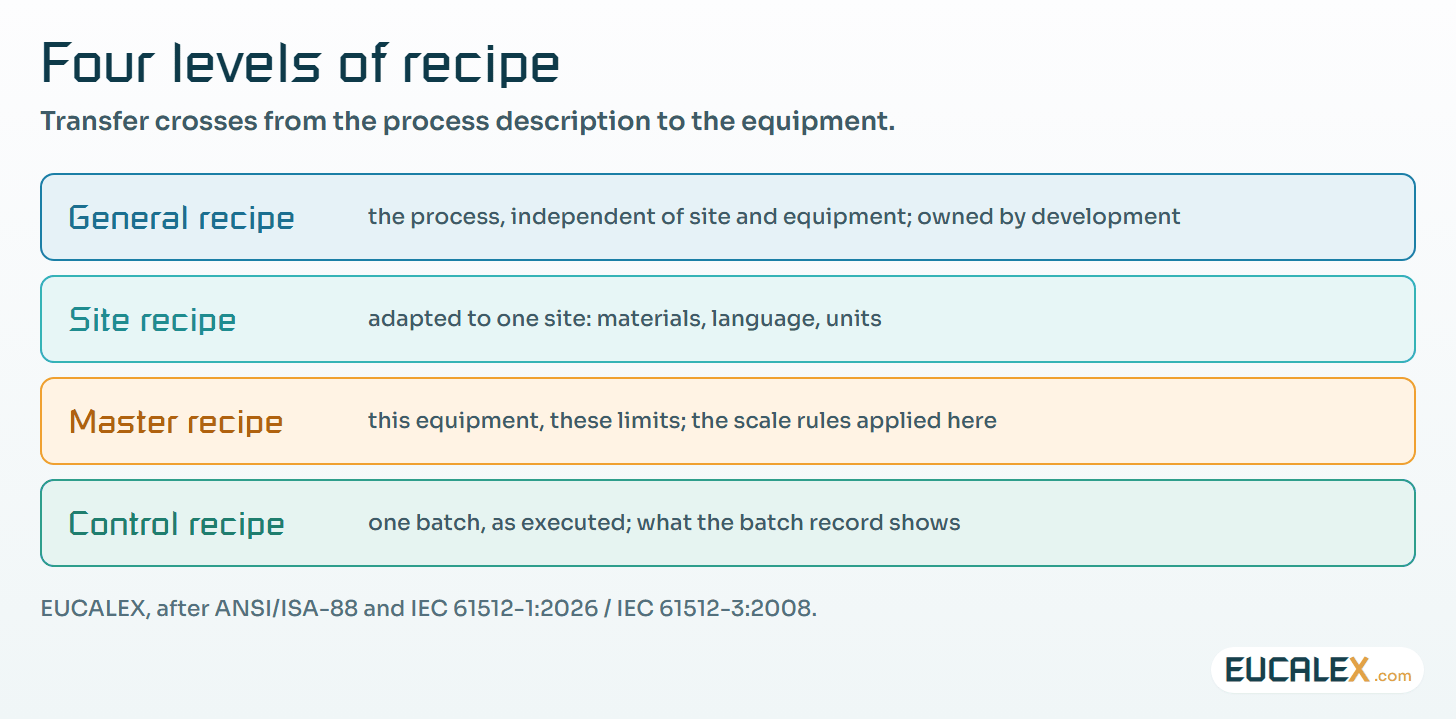
In theory, technology transfer moves a general recipe down to a master recipe. In practice, on most sites I have worked with, the general recipe does not exist as a managed object. It is a development report in PDF, a few slides and a spreadsheet kept with more care than the report. An automation or MES engineer at the receiving site reads them and types values into a recipe editor. That engineer is usually careful, and is very often the first person in the chain who was not in the room when the process was developed. When the general level is skipped, the translation from process need to equipment setting still happens. It just happens silently, without the rule that should drive it.
Where the handoff breaks on site
The same handful of failures turns up on solid dose lines, in API plants and in biologics suites, whatever the software.
- The spreadsheet that survives every transfer. A development working file that became, without anyone deciding it, the source of truth. No audit trail, three versions in circulation. When it disagrees with the report, people trust the spreadsheet.
- Scale-dependent values copied as constants. Agitation in rpm instead of tip speed, a mixing time instead of an end point, a heating ramp the commercial jacket cannot deliver.
- Units and bases that drift. Percent of batch weight against kilograms, gauge against absolute pressure. Each conversion is easy, and each is a place to be wrong unnoticed.
- One field for three ranges. Development reports a proven acceptable range; production needs a set point, an operating range and alarm limits. Many recipe editors offer one minimum and one maximum.
- Knowledge hidden in prose. ‘Add slowly’, ‘allow to settle’. The WHO guideline lists the order and method of raw material addition and hold times among what the sending unit must hand over (§12.16). A recipe needs them as steps, conditions and timers.
- Names that do not match. The dossier, the report and the recipe tag call the same parameter three things, and nobody can say quickly which recipe values are critical.
After the handoff: who may change the recipe
The transfer has an end date; the learning does not. Development keeps learning from later studies, the receiving site from every batch. The question for the next five years is how a change on either side reaches the master recipe, and who decides.
ICH Q12, adopted on 20 November 2019, gives that question its regulatory edge. Established conditions are ‘legally binding information considered necessary to assure product quality’, and any change to them needs a regulatory submission. Process parameters whose impact on quality ‘cannot be reasonably excluded’ are among them. Q12 proposes a product lifecycle management document as ‘a central repository for the ECs and the associated reporting category’, while noting that regional legal frameworks decide how far its tools apply.
On site, every parameter in the master recipe should therefore carry, where the recipe author and the change control board can see it, whether it is an established condition, where it comes from and which document revision set it. Without that, a process engineer can widen a range under local change control that the dossier does not allow. Anything that reads the recipe is affected too: if batch review runs on rules derived from the master data, as in review by exception, a recipe change silently changes what the review checks. Whether the link lives in a knowledge management tool or a controlled register, the logic is the same. Tools help once the structure exists. They do not create it.
A parameter-by-parameter check
The most useful transfer document is rarely the biggest. It is a register, one line per parameter, that follows each value from where it was established to where it runs, and someone who actually walks it against the recipe.
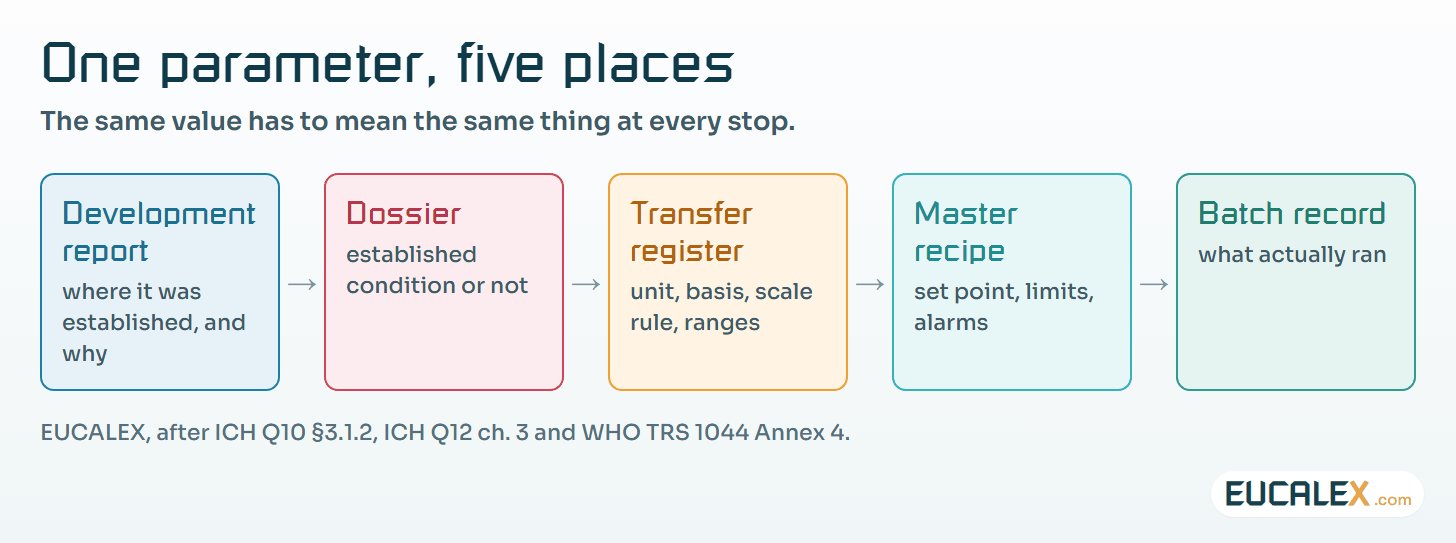
| Check | How | What it catches |
|---|---|---|
| Identity | Map every critical parameter and established condition to one recipe parameter and one name | Missing or duplicated parameters |
| Unit and basis | Unit, reference and scale rule | rpm copied where a tip speed was meant |
| Ranges | Acceptable range, operating range, set point and alarm limits kept apart | A development range loaded as a control limit |
| Sequence and time | Additions, hold times and end points as recipe steps | Knowledge that lived in one sentence |
| Source | Report, revision and section for each value | A value from an outdated spreadsheet |
| Status | Established condition or not | A range widened without the regulatory step |
The first engineering batch
An engineering batch is usually judged on yield and a few tests. A batch can pass and still run on the wrong parameter, so treat it as the dress rehearsal of the recipe as well.
- Compare at parameter level. Put the executed control recipe next to the development batches: speeds, times, temperatures, end points.
- Read the screens against the register. Someone who did not build the recipe checks each value the operator sees. An afternoon finds more than a week of document review.
- Let production run it. Annex 15 expects production personnel in validation batches ‘to facilitate product understanding’ (§5.11). Their questions are cheapest now.
- Log transfer findings as transfer findings. A step operators had to interpret is a gap in the recipe, not an operator issue. Close it before the validation batches, which Annex 15 normally expects at commercial scale (§5.8).
Where to start
- Pick one product in transfer and build its parameter register with the six checks.
- Agree a template for the transfer data package: name, unit, basis, scale rule, ranges, source and status per parameter, with the WHO appendix as the list of documents around it.
- Give each parameter one name across dossier, report and recipe, or keep a controlled cross-reference.
- Decide who owns the master recipe after go-live, and how a change raised by development reaches the receiving site’s change control.
- Keep the general level alive in the recipe structure: with phases separated from equipment logic, as in automating a biologics process, the scale rule has a place to live. The map in from molecule to batch release shows the systems it crosses.
- Only then look at software. A tool speeds up a transfer that has a structure, and faithfully reproduces the confusion of one that has none.
Five common mistakes
- Transferring documents instead of knowledge. Every item delivered, and nobody at the receiving site can explain a value.
- Copying set points without their scale rule. The usual cause of a first batch that ‘behaves differently’.
- Squeezing three ranges into one field. They do different jobs.
- Leaving the spreadsheet in charge. Bring it under control or retire it.
- Changing recipe values blind to their status. The local change looks minor until someone compares it with the dossier.
The computerised systems that hold master recipes fall under EU GMP Annex 11, still, like Chapter 4, the January 2011 text; the revised drafts consulted on in 2025 are not final yet. Whatever their final wording, no rule fixes a handoff that relies on retyping values nobody at the keyboard derived.
A transfer is finished when the receiving site can explain every value in its master recipe without phoning the lab that set it.
References
- ICH, Q10 Pharmaceutical Quality System, Step 4, 4 June 2008, §3.1.2.
- ICH, Q12 Technical and Regulatory Considerations for Pharmaceutical Product Lifecycle Management, adopted 20 November 2019, chapters 3 and 5.
- WHO, TRS 1044, Annex 4: WHO guidelines on technology transfer in pharmaceutical manufacturing, 2022, §1.7, §12.16 and Appendix 1.
- EudraLex Volume 4, Chapter 4: Documentation, into operation since 30 June 2011, §4.17–4.18.
- EudraLex Volume 4, Annex 15: Qualification and Validation, into operation since 1 October 2015, §5.8, §5.10 and §5.11.
- European Commission, stakeholders’ consultation on EudraLex Volume 4, Chapter 4, Annex 11 and Annex 22, 2025.
- IEC, IEC 61512-1:2026, Batch control, Part 1: Models and terminology, edition 2.0, 20 February 2026; ISA, ISA-88 series of standards.
- K. Biehler, ‘Standardized Foundation, Faster Development Pipeline’, InTech, December 2022, pp. 20-23 (the starting point of this article). isa.org
Related articles
All articles- Automating a biologics process: recipes, PAT, continuous runs and the data a GMP site must specifyBiologics plants are moving from vendor skids that each keep their own recipe and their own clock to connected, partly continuous trains. What…
- Review by exception: what changes for the QA reviewer, the operator and the Qualified PersonReview by exception turns batch review from reading hundreds of pages into judging a short list. What changes for operators, QA reviewers and the…
- From molecule to batch release: where the digital systems actually attachA walk through drug development and manufacture (preclinical, three clinical phases, marketing authorisation, then granulation, compression, sterile…
EUCALEX
Have a project or a technical challenge?
Contact us: we will be pleased to discuss it with you, with no commitment.
Discuss your project with usStay informed
Receive new EUCALEX articles and technical insights by email.