
Through the wall, in the room or on the machine: where cleanroom automation hardware belongs
The walk-down is in its second hour when someone finally turns the operator panel round. From the grade B side it looked right: a stainless arm, a flat touchscreen, a front plate with an ingress protection (IP) rating of IP65. Behind it, the box has a ventilation grille, four exposed screw heads and a cable gland whose seal has gone yellow under the sporicidal wipes. The front has been wiped twice a shift for months. Nobody has wiped the back, because nobody planned for anyone to reach it.
On the projects we support, that scene is ordinary. The machine builder chose the panel, the catalogue chose the enclosure, and the cable chose the position. None of those choices was made as a contamination control decision, which is what Annex 1 of the EU good manufacturing practice (GMP) guidelines turns it into. Where automation hardware sits around a cleanroom has to be fixed in the user requirements specification (URS), and the IP code on the label answers a question about water, not about a cleanroom.
What Annex 1 asks of a box with electronics inside
Annex 1, dated 22 August 2022 and in operation since 25 August 2023, never mentions a cabinet, a drive or a panel personal computer (PC). Five of its clauses decide where they go all the same.
- §4.5, surfaces. In cleanrooms and critical zones, “all exposed surfaces should be smooth, impervious and unbroken”. A ventilation slot, a membrane keypad lifting at one corner or a bare screw head fails that sentence.
- §4.6, recesses. There should be no recesses that are difficult to clean, so “projecting ledges, shelves, cupboards and equipment should be kept to a minimum”. The flat top of an enclosure is a ledge.
- §4.7, materials. Items used in the room should be made of materials chosen “to minimize generation of particles and to permit the repeated application of cleaning, disinfectant and sporicidal agents where used”. No IP rating answers this one.
- §5.3, maintenance. “As far as practicable”, equipment, fittings and services should be designed and installed so that operations, maintenance and repairs can be performed outside the cleanroom.
- §6.6, services. Pipes, ducts and other utilities “should not be present in cleanrooms”, and where they are unavoidable they should be installed without recesses, unsealed openings or surfaces that are difficult to clean. To the cleaning team, a cable tray is a utility.
Two more clauses complete the picture. §4.36 asks that vapour disinfection, such as vapour-phase hydrogen peroxide (VHP), is understood and validated, and the hardware in the room is part of what the cycle must reach. And §4.9 prohibits sinks and drains in grade A and B areas. Nobody hoses down a grade B room. The daily attack on the hardware is a wipe soaked in alcohol or sporicide, and the periodic one is a gas.
Four places for the control hardware
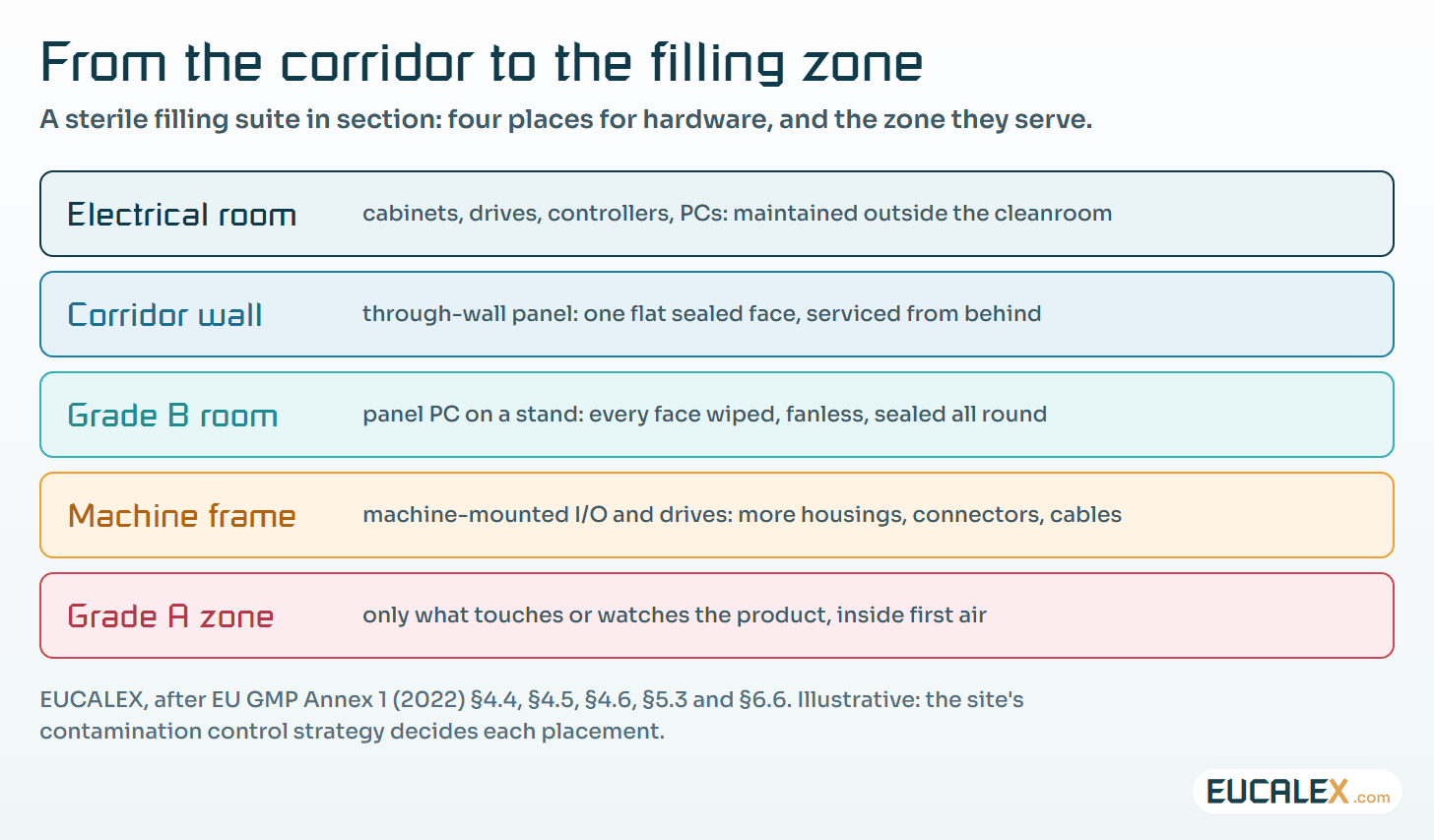
Annex 1 §4.4 defines four grades. Grade A is the critical zone, such as the filling zone, normally under unidirectional airflow inside a restricted access barrier system (RABS) or an isolator. Grade B is its background. Grades C and D host less critical stages. Seen in section from the filling needle outwards, a sterile suite offers four places for control hardware, each trading cleaning effort in the room against maintenance effort outside it.
- The technical corridor or electrical room. Controllers, drives, power supplies and industrial PCs sit in ordinary cabinets outside the classified envelope. The questions become cable length, wall penetrations and where the heat goes.
- Through the wall. The operator panel is flush-mounted in the cleanroom wall and opened from the corridor. The room sees one flat face and a seal; the technician never gowns to replace it.
- In the room. A panel PC on a pedestal or an arm, where the operator must read the screen while working. Every face is in the room, including the back and the cable entry.
- On the machine. Distributed input/output (I/O) modules and motors with integrated drives mounted on the frame, which machine builders call cabinetless design. Fewer cabinets, more small housings and connectors.
| Placement | Cleaning in the room | Maintenance | What to specify | What the IQ verifies |
|---|---|---|---|---|
| Technical corridor or electrical room | Wall penetrations only | Outside the cleanroom, as Annex 1 §5.3 prefers | An ordinary industrial cabinet; sealed, cleanable penetrations | Penetrations sealed on the cleanroom side; cabinet built to the drawings |
| Through the wall | One flat face and its perimeter seal | From the corridor, no gowning | Front face and seal resistant to the site’s agents; rear door on the corridor side | Continuous seal; front materials as specified; nothing serviceable from the room |
| In the room | Every face, the arm joint, the cable entry | In the room, under gowning and a written work protocol | Fanless, sealed all round, no exposed fasteners, agent compatibility | Materials of construction; sealed cable entry; no vents; mounting as drawn |
| On the machine | Many small housings, connectors and cable runs | At the machine, inside the classified room | The hygienic design basis of each housing; cable routing and caps | Each device and connector as specified; caps fitted; cables routed and fixed as drawn |
The IP code answers a water question
IEC 60529 is the standard behind the IP code. Its consolidated edition 2.2, published in August 2013 with Amendment 2, added the second characteristic numeral 9, protection against water projected at high pressure and high temperature; after its first corrigendum the test water is at (80 ± 5) °C. Three details of that text matter more to a pharmaceutical buyer than any pressure figure.
- The tests use fresh water. Clause 6 warns that the actual protection “may not be satisfactory” if cleaning uses high-pressure, high-temperature jets beyond numeral 9 “and/or solvents”. Disinfectants, sporicides and VHP are simply not part of the test.
- Numeral 9 does not include 5 and 6. Up to numeral 6 a higher number covers the lower ones. An enclosure marked 7, 8 or 9 only is “considered unsuitable” for water jets unless it carries a multiple code, such as IPX6/IPX9.
- IP69K is not an IEC 60529 code. The IEC text has no K suffix. Machine builders quote it from the road-vehicle IP standards: the German DIN 40050-9 of 1993, now withdrawn, and ISO 20653, whose third edition came out in August 2023. Ask which standard and which laboratory stand behind the marking.
An IP65 front with an open back is also common. On a through-wall panel that is the right design. On a panel PC standing in the room it is a gap in the specification.
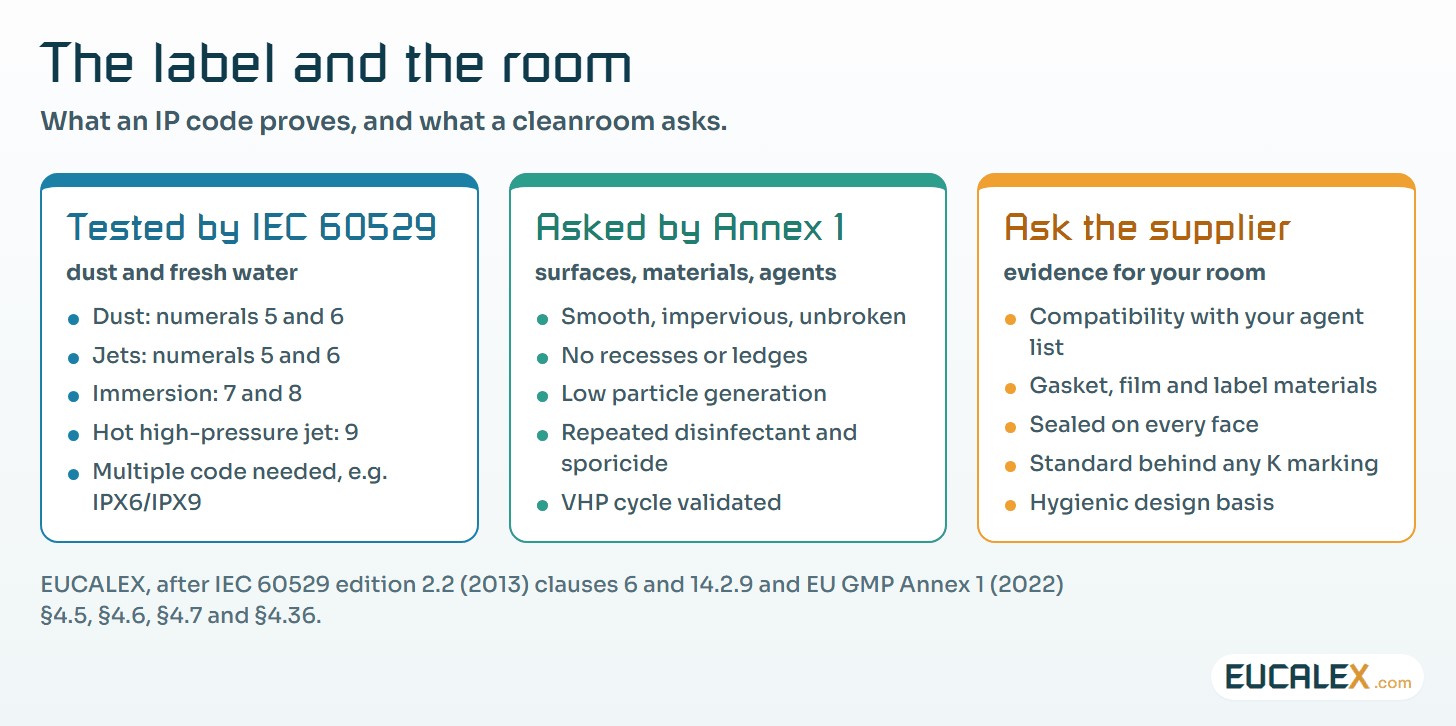
What the room needs is evidence against the agents actually used. On the sites we assess, the steel is rarely the first thing to fail under repeated wiping and VHP cycles; gaskets, touch films, polycarbonate windows, labels and cable glands go first. The cleaning procedure already lists the agents and their contact times. Put that list in the URS and ask the supplier to state compatibility against it, part by part.
Cabinetless on a sterile line: fewer boxes, more surfaces
The case for cabinetless machines, made in an InTech feature of November 2020 written by a vendor, rests on floor space, shorter wiring and modular machines. In a packaging hall or a grade D compounding area it is a sound argument. Moved under a grade A zone, every advantage changes sign.
Each machine-mounted housing is an exposed surface under §4.5, each connector a potential recess under §4.6, each cable along the frame a utility under §6.6. A motor with its drive built in brings the drive’s heat into the zone, where §4.4 asks for unidirectional airflow qualified across the whole grade A area and §7.18 asks that first air is not obstructed. Every box near the filling needles joins the airflow visualisation study.
Maintenance moves too. A drive in a corridor cabinet is swapped by an electrician with a screwdriver. A drive on the frame is swapped inside the classified room, the case §5.3 asks to avoid and otherwise to manage with restricted access, work protocols, extra cleaning and monitoring. If the equipment is critical to sterility and the swap unplanned, §5.7 asks for a recorded impact assessment.
None of this rules cabinetless hardware out; it decides where it belongs. On the lines we see working well, motors and I/O sit below the machine table or outside the barrier, grade A holds only what must touch or watch the product, and machine-mounted hardware stays in grade C and D areas and secondary packaging.
For the housings themselves, ISO 14159:2002 sets hygiene requirements for machinery used where hygiene risks to the consumer of the product can occur. The European Hygienic Engineering and Design Group (EHEDG) Doc. 8, Hygienic Design Principles (third edition, March 2018), was written for food equipment and carries over by analogy. The Bioprocessing Equipment (BPE) standard of the American Society of Mechanical Engineers (ASME), edition BPE-2024, covers the process side. Ask each supplier which one its housings were designed against.
Choosing the industrial PC you will have to requalify
An InTech feature of June 2023 on industrial PCs makes the familiar points: hardened enclosures, tolerance of heat and vibration, long availability. On a GMP line, four other properties decide whether the PC lasts without a deviation.
- No fan. A fan draws room air through the electronics and blows it back out. Annex 1 §4.7 asks for materials that minimise particle generation; a fanless, sealed unit removes the question.
- A written availability commitment. Ask how long the same hardware revision will be supplied and how changes are notified. A new board revision brings new drivers, a new image and a change control.
- The image is configuration. Annex 11 §10 asks that changes, “including system configurations”, are made only in a controlled manner. Keep a versioned golden image with its hash, and restore it once on the spare before you need it.
- A pre-imaged spare in the store. Qualified, labelled, with the restore procedure beside it. Otherwise the PC that fails on a Friday night is replaced by whatever the night shift can find.
The panel PC is also a Windows or Linux host on the plant network, and it should sit in a defined security zone like any other; zones and conduits, starting from the risk sets out how to draw them before the switch is bought.
What the URS and the IQ should check
Annex 15 §3.2 asks for the essential elements of quality to be built into the URS, the reference for the whole validation life cycle. How to write each line so it can be tested is covered in writing a URS that actually drives the qualification. For control hardware around a cleanroom, six lines do most of the work.
- Placement per device, by room grade, with the reason when anything sits inside grade A or B.
- Cleaning and decontamination agents, copied from the cleaning procedure, and the supplier’s compatibility statement for every exposed material.
- Enclosure construction for every in-room device: sealed on all faces, no vents, no exposed fasteners, and the IP code with its standard and multiple coding.
- Maintenance access from outside the cleanroom wherever practicable, and the work protocol where it is not.
- Heat and airflow for anything in or near grade A, so that the airflow visualisation study includes it.
- Lifecycle and configuration for every industrial PC: availability commitment, change notification, golden image and spare.
The installation qualification (IQ) then proves what was installed. Annex 15 §3.9 lists verification of the installation “against the engineering drawings and specifications” and of the materials of construction: seals, materials and cable routing checked on the installed device, not on its data sheet. Where that check sits is set out in what each qualification stage proves, and how deep to test it in tying test depth to risk.
Where to start
Take the agent list from the cleaning procedure of one classified room and walk round every piece of control hardware in it, front and back. Note each vent, exposed fastener, lifted film, discoloured gasket and open cable entry. It takes an afternoon, and the list is the first draft of your URS lines.
Then sort the findings by placement. What can move to the corridor or into the wall goes on the next shutdown plan; what must stay gets a compatibility statement from its supplier.
Five common mistakes
- Reading IP65 as cleanroom grade. The code covers dust and fresh water. Agents and particles are outside its scope.
- Specifying IPX9 and expecting IPX6. Without multiple coding, numeral 9 says nothing about ordinary water jets.
- Leaving the back to the machine builder. An in-room panel is cleaned on every face, and the URS must say so.
- Moving cabinetless design into grade A unchanged. The arguments for it in a packaging hall turn into cleaning, airflow and maintenance problems under first air.
- Treating the panel PC as a commodity. Its hardware revision and its image are part of the validated state, and an unplanned replacement is a change.
A control enclosure in a cleanroom is judged on the same terms as the wall it stands against. If the specification does not say so, the cleaning team finds out first.
References
- European Commission, EudraLex Volume 4, Annex 1, Manufacture of Sterile Medicinal Products, C(2022) 5938, 22 August 2022, §4.4 to §4.9, §4.36, §5.2, §5.3, §5.7, §6.6 and §7.18.
- European Commission, EudraLex Volume 4, Annex 15, Qualification and Validation, §3.2 and §3.9, and Annex 11, Computerised Systems, §10.
- IEC, IEC 60529:1989/AMD2:2013, Degrees of protection provided by enclosures (IP Code), consolidated as edition 2.2, clauses 6 and 14.2.9.
- ISO, ISO 14159:2002, Safety of machinery, Hygiene requirements for the design of machinery.
- EHEDG, Doc. 8, Hygienic design principles, third edition, March 2018.
- ASME, BPE-2024, Bioprocessing Equipment, issued 29 April 2024 (contents and front matter).
- ISA, InTech, Is the future of machine design cabinetless?, November/December 2020, and “Industrial Computers: Robust and Ready”, InTech, June 2023: the trade features that prompted this article.
Related articles
All articles- DQ, IQ, OQ, PQ: what each qualification stage proves, and what it cannotFrom the quality concept and the URS to the PQ, one question per stage. A plain reference for the engineers and technicians who sign qualification…
- Writing a URS that actually drives the qualification, and deciding whether you need a DQA user requirements specification is either the root of every test that follows or a wish list nobody can test. How to write it one line at a time…
- Zones and conduits: start from the risk, not from the switchThe most common segmentation mistake is to design the network first and reverse-engineer the justification. It produces a beautiful diagram that…
EUCALEX
Have a project or a technical challenge?
Contact us: we will be pleased to discuss it with you, with no commitment.
Discuss your project with usStay informed
Receive new EUCALEX articles and technical insights by email.