
Calendar maintenance or condition monitoring on GMP equipment: what the P-F interval allows
The work order said “supply fan, air handling unit 4: replace bearings, every 12 months”, and it was due. On a sterile filling site that fan feeds a grade C corridor, so the job meant a planned stop, a broken pressure cascade, a clean-down and a check of the room pressure differentials before production could restart. The fitter took out two bearings that looked, in his words, like new. Six weeks later the extract fan beside it seized on a Saturday night, halfway between two of its own scheduled replacements.
The scene is a composite, but we meet it in one form or another on most good manufacturing practice (GMP) sites we assess. The calendar task is kept because it is “validated”, which usually means it is written in a procedure an inspector has read. The GMP texts ask for maintenance at appropriate intervals, against written schedules, with records. None of them asks for a calendar.
Where a failure gives warning, a condition task run at the right interval protects the product better than a fixed date, and moving from one to the other is an ordinary change under change control. What follows covers which failures warn, for how long, what to measure on a fan, a water-for-injection (WFI) pump or a centrifuge, and how to write the change so that quality assurance (QA) can sign it.
What the GMP texts ask of maintenance
In the United States, 21 CFR 211.67(a) requires equipment to be cleaned and maintained “at appropriate intervals to prevent malfunctions or contamination” that would alter the drug product. Paragraph (b)(2) asks for written “maintenance and cleaning schedules”, and paragraph (c) for records of the maintenance performed. The interval has to be appropriate; nothing says it has to be fixed in weeks.
The EU text is shorter. EU GMP Chapter 3, in the version in operation since 1 March 2015, says in §3.34 that manufacturing equipment “should be designed, located and maintained to suit its intended purpose”, and in §3.35 that “repair and maintenance operations should not present any hazard to the quality of the products”. Measuring and control equipment is different: §3.41 asks for calibration “at defined intervals”, and that clause stays as it is.
Annex 15 (2015) adds the qualification view: under §4.1, equipment and utilities “should be evaluated at an appropriate frequency to confirm that they remain in a state of control”, and under §4.2 a fixed requalification period “should be justified”.
Appropriate to what? To the way the item fails. §3.35 adds an argument maintenance teams rarely use: opening an air handling unit (AHU) above a classified room is itself a hazard to the product, so a task that opens equipment for nothing has a GMP cost as well as a budget one.
Why the calendar misses most failures
Calendar maintenance assumes that failure probability rises with age. The airline studies that founded reliability-centred maintenance (RCM) found otherwise. The 2008 RCM guide for facilities of the US National Aeronautics and Space Administration (NASA) quotes the Nowlan and Heap report of 1978: “contrary to expectations, for many items the likelihood of failure did not in fact increase with increasing operating age.”
The same guide summarises three studies (United Airlines in 1968, a Swedish study in 1973, the US Navy in 1982): random failures made up between 77 and 92 per cent of the total, age-related ones between 8 and 23 per cent. It adds that “in many cases scheduled overhaul increases the overall failure rate by introducing a high infant mortality rate into an otherwise stable system.”
Those studies come from aircraft and ships, not pharmaceutical plants, but the parts are the same: rolling bearings, seals, belts, motors. The guide names where age limits do work: simple items subject to wear or designed as consumables. On a GMP site those keep their fixed tasks. Diaphragms in sanitised water valves, for instance, are usually changed on a count of sterilisation cycles, because their degradation is hidden inside the valve.
The P-F curve, read on a fan bearing
The P-F curve plots the condition of one failure mode against time. P is the point at which the degradation becomes detectable; F is the functional failure. The time between them is the P-F interval, the only window in which a condition task can do anything. The InTech feature behind this article reminds its readers that the curve “is a conceptual representation only and does not have any units or scale”. Its shape is real; its timescale has to come from your own machines.
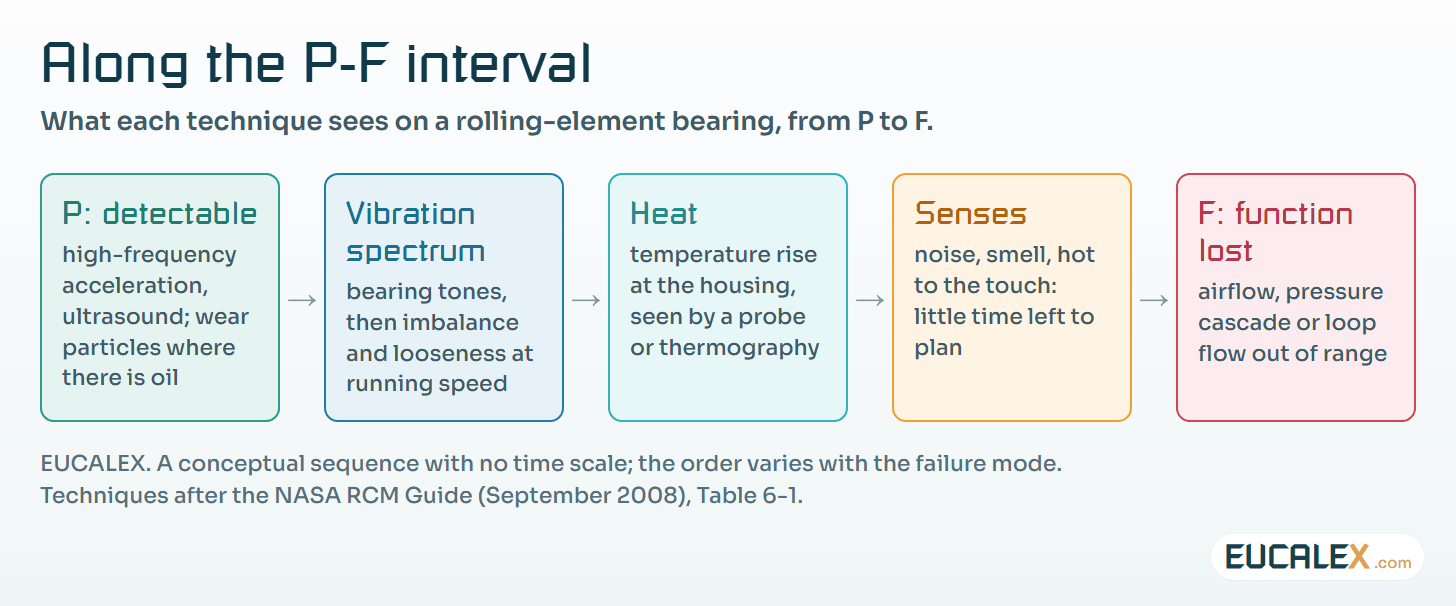
The technique sets where P sits: high-frequency acceleration sees a bearing defect long before anyone hears it. The inspection interval then eats into the window. A monthly route loses up to a month of warning; a fixed sensor read every minute loses almost none. The working rule on the sites we assess is to look at least twice within the shortest P-F interval you expect.
NASA’s guide gives the next step. Once an alert limit is exceeded, the monitoring interval “should be reduced to between one-third and one-quarter of the prior interval”: from quarterly to three or four weeks. Its own example is a fan running at 0.2 inch per second (about 5.1 mm/s), closer to failure than an identical fan at 0.1 (about 2.5 mm/s) and so watched more often.
F is defined by the room, not by the bearing
A mechanic’s functional failure is a seized bearing. A GMP functional failure comes earlier. NASA’s guide makes the general point: the function of a pump must be defined in terms of flow rate, discharge and suction pressure and efficiency, not as “moves water”.
On a cleanroom supply fan, F is the moment the airflow can no longer hold the room’s pressure differential or its design air changes. A slipping belt reaches it while the bearings are fine. On a WFI distribution pump, F is a loop return flow or temperature outside the specified range. On a process centrifuge, F is a vibration trip in the middle of a batch.
Defining F this way shortens the P-F interval you can count on and places the alarm where it leaves time to plan the work outside production. It also turns signals you already record (fan speed against pressure differential, pump current against loop flow) into condition indicators.
Which tasks can move, and which stay on the calendar
| Asset | Main failure modes | Does it warn in time? | What happens to the calendar task |
|---|---|---|---|
| AHU supply or extract fan, belt drive | Bearing wear; belt wear and misalignment; impeller fouling and imbalance | Yes: vibration velocity and acceleration envelope, motor current, fan speed against room pressure differential | Bearing replacement moves to condition; the belt check stays periodic and can be stretched on as-found evidence |
| WFI or purified water distribution pump | Bearing wear; mechanical seal wear; cavitation | Bearings yes, by vibration; seals barely, a leak gives little notice; cavitation yes, by suction pressure and noise | Bearings on condition; seal kept on a schedule or replaced on first weep with the spare on the shelf |
| Process centrifuge | Imbalance; bearing wear; drive faults | Yes, and most machines carry their own vibration trip | Trend the trip channel; inspections the manufacturer makes mandatory stay as written |
| Terminal high-efficiency particulate air (HEPA) filters | Loading; leaks in the media or seal | Loading yes, by pressure differential; a leak gives no warning to a gauge | Change on pressure differential; the integrity test stays periodic |
| Measuring instruments | Drift | Partly, by comparing redundant or duplicate readings | Calibration stays at defined intervals (EU GMP §3.41); the interval may change on as-found data |
Which vibration standard applies, and what it does not tell you
The trade feature on vibration transmitters behind this article sets its alarm levels from ISO 10816-1:1995. ISO has withdrawn that edition: ISO 20816-1:2016 replaced it, together with ISO 7919-1:1996 on shaft vibration, and its criteria cover both vibration magnitude and change of vibration. For machines above 15 kW running between 120 and 30,000 r/min, ISO 20816-3:2022 replaced ISO 10816-3:2009.
Most AHU fans fall outside ISO 20816-3. A note in its scope says its criteria generally apply only to fans rated above 300 kW, or to fans that are not flexibly supported. Smaller fans belong to ISO 14694:2003 (amended in 2010), which sets balance and vibration limits for fans below 300 kW. Rotodynamic pumps with the impeller mounted on the motor shaft, the usual sanitary WFI pump, are sent by ISO 20816-3 to ISO 10816-7.
One sentence in ISO 20816-3 deserves a second reading: its requirements “do not address the diagnostic evaluation of the condition” of gears or bearings. A zone limit says how severe the overall vibration is, not that an outer race is pitted. For that you need a trend against the machine’s own baseline, ideally recorded when the fan was new, one more reason to shape the factory and site acceptance tests a supplier runs for you.
NASA’s guide sets the alert at a statistically significant deviation, usually two standard deviations from the mean, and the alarm at three. That is the logic of a Shewhart chart: control charts for ongoing process verification explains why a control limit is not a specification. A vibration alert is a reason to look closer and sooner, not a failure.
Where the condition data lives
Condition data reaches a site by a portable collector carried on a route, by transmitters that turn an accelerometer signal into 4-20 mA for an existing programmable logic controller (PLC) or building management system, or by wireless sensors reporting to a vendor’s server. ISO 17359:2018 gives the general procedure for setting up the programme, ISO 13374-1:2003 the guidelines for processing and presenting the data.
The GMP question is narrower: which record proves the maintenance decision? It should be the computerised maintenance management system (CMMS) work order, with the as-found condition and a snapshot of the trend that triggered it. That snapshot needs the measuring point, the unit and band (mm/s root mean square, 10 to 1,000 Hz for instance), the sensor and the date, as the article on metadata that makes the number mean something explains.
Vibration alerts belong to maintenance, not to the operator’s alarm list: an alert that needs no operator action within minutes is not an alarm, as the article on alarm load for the GMP operator sets out.
Our article on AI that survives a quality review counts predictive maintenance on utilities among the easy cases, with no validation cliff to climb. That holds for the model. Once its output removes a scheduled task on equipment that touches the product, the programme change goes through change control, and the data behind it has to be good enough to carry the decision.
Changing the task under change control
Annex 15 §11.2 asks for written procedures for any planned change to equipment that may affect product quality. §11.4 asks for quality risk management to evaluate the impact of a planned change, including on “calibration, maintenance”. §11.6 asks for the supporting data to be reviewed before final approval, and §11.7 for an evaluation of the change’s effectiveness. A move from calendar to condition fits that frame without a special procedure.
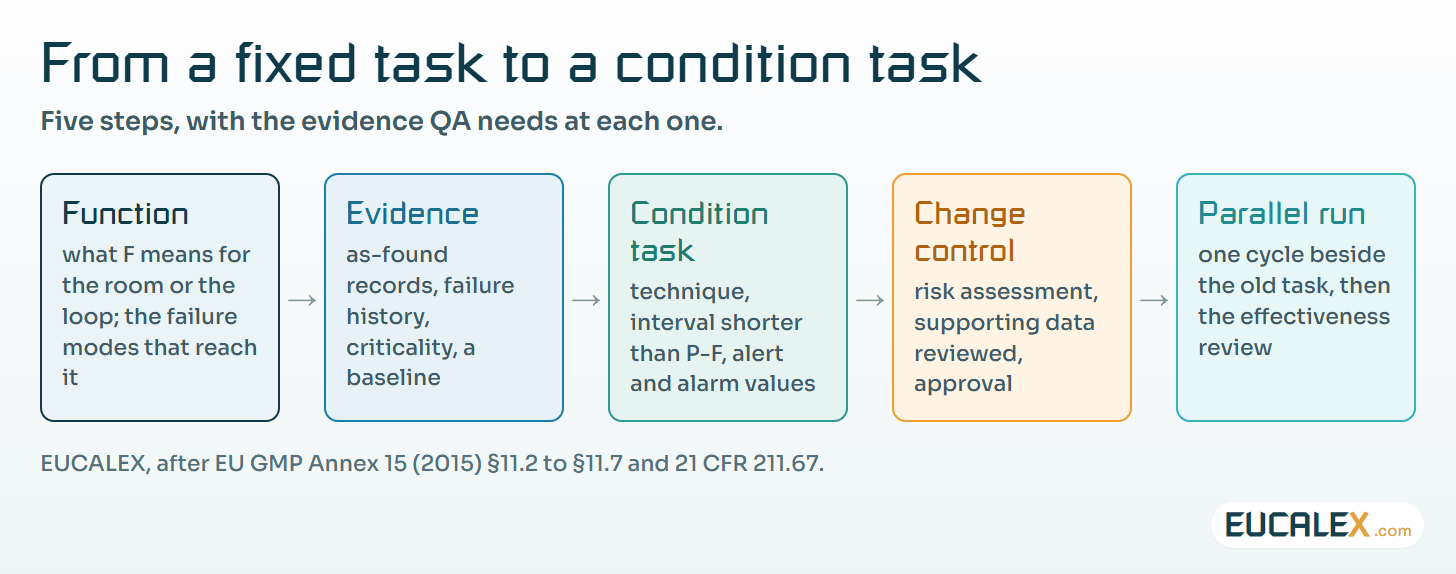
The evidence is usually already on site. The as-found records of past replacements are the best of it: two bearings that looked like new are data, provided someone wrote it down. Add the failure history from the CMMS, the criticality of the asset to the room or the loop it serves, and a baseline measured before the change.
If the change file says RCM, expect a reviewer to hold it against the standard of the Society of Automotive Engineers (SAE) International on evaluation criteria for RCM processes (JA1011, issued in August 1999, revised in November 2024). Moving one fan to condition monitoring does not need a full RCM study; it needs the failure mode, the evidence and an honest name for the method.
Run both tasks in parallel for one cycle. The calendar replacement goes ahead, its as-found condition is compared with what the trend predicted, and the comparison becomes the effectiveness evidence §11.7 asks for.
Repair, replace or retrain
When the trend crosses the alarm, there are three answers, and the third is the one most often forgotten. A sponsored Automation.com feature put the same question to machine-tool shops; on a GMP site, each answer is weighed by what it does to the qualified state.
- Repair. A like-for-like bearing, belt or seal, fitted under the maintenance procedure, followed by the functional check the procedure defines. Record the as-found condition, because it feeds the next P-F estimate.
- Replace. A different fan, motor or pump is a change of equipment: change control, and a requalification scoped to what the new item can affect.
- Retrain. Some failure modes come from the way the equipment is run. A pump that cavitates every time a sanitisation sequence opens the wrong valve first, or a belt tensioned by feel, will fail again after any repair. The fix is in the sequence or the work instruction, and in the people who use them.
Where to start
- Count what the calendar found. Pull the as-found records of the last replacements on one critical AHU fan and its twin. A single page with the number found worn and the number found sound is the first piece of evidence.
- Measure a baseline. Take vibration readings on both fans, set alert and alarm values from them, and read them monthly while the calendar task continues.
- Raise the change at the next maintenance review. Attach the page, the baseline and the alarm logic, and agree with QA when the effectiveness review will take place.
Five common mistakes
- One limit for every machine. A zone limit from a standard sorts severity; it does not replace a trend against each machine’s own baseline.
- Stretching the calendar with nothing in its place. “We skipped it once and nothing happened” is luck, not evidence.
- Looking less often than the P-F interval. A quarterly route on a failure mode that gives four weeks of warning will miss most of them.
- Sending vibration alerts to the operator. They belong in maintenance planning, with a named owner and a response time.
- Losing the evidence. A trend left in a vendor portal and a work order that says “OK” prove nothing at inspection; the snapshot and the as-found condition belong in the CMMS record.
The calendar is easy to defend because nobody has to explain it. A condition task asks for one more explanation, and gives back a warning before the room loses its pressure.
References
- 21 CFR 211.67, Equipment cleaning and maintenance: ecfr.gov
- EudraLex Volume 4, EU GMP Part I, Chapter 3, Premises and Equipment (in operation 1 March 2015), §3.34, §3.35, §3.41: health.ec.europa.eu
- EudraLex Volume 4, Annex 15, Qualification and Validation (in operation 1 October 2015), §4 and §11: health.ec.europa.eu
- NASA, Reliability-Centered Maintenance Guide for Facilities and Collateral Equipment, September 2008, §2 and §4.1: nasa.gov
- ISO 17359:2018, Condition monitoring and diagnostics of machines, General guidelines: iso.org
- ISO 20816-1:2016, Mechanical vibration, Measurement and evaluation of machine vibration, Part 1: General guidelines: iso.org
- ISO 20816-3:2022, Part 3: Industrial machinery with a power rating above 15 kW and operating speeds between 120 r/min and 30 000 r/min: iso.org
- ISO 14694:2003, Industrial fans, Specifications for balance quality and vibration levels: iso.org
- SAE JA1011, Evaluation Criteria for Reliability-Centered Maintenance (RCM) Processes, revised November 2024: sae.org
- Trade features used as starting points: Improving maintenance by adopting a P-F curve methodology, InTech, March/April 2019 (isa.org); Condition Monitoring Using Vibration Transmitters and PLCs, Automation.com, July 2022 (automation.com); The Replace, Repair or Retrain Decision, Automation.com, 28 May 2025 (automation.com)
Related articles
All articles- Control charts for ongoing process verification: what Stage 3 asks, and how to read the process, not the specEvery batch passed, and the process still drifted. What FDA Stage 3 and EU GMP Annex 15 actually ask of continued process verification, which chart…
- Forty alarms at three in the morning: alarm management for the GMP operatorAn alarm system is judged by one person, at night, in the first minutes of an upset. What counts as an alarm on a GMP site, what ISA-18.2, IEC 62682…
- AI on an industrial site: three use cases that survive a quality reviewMost industrial AI pilots die in the quality department, not in the model. The ones that live share one trait: they inform a human decision instead…
EUCALEX
Have a project or a technical challenge?
Contact us: we will be pleased to discuss it with you, with no commitment.
Discuss your project with usStay informed
Receive new EUCALEX articles and technical insights by email.