
Energy metering on a GMP site: what to measure, and which savings reopen qualification
The request usually arrives from group finance or the sustainability team, and it looks simple: the site’s energy consumption, split by use, for the energy audit. The utilities engineer opens the building management system and finds the supplier’s electricity meter, the gas meter, a water meter on the main, and a handful of power readings on the larger switchboards. The water for injections (WFI) still, the clean steam generator and the chillers have no meter of their own.
So the split is estimated from nameplates and running hours, the audit is signed, and the recommendations land on systems that nobody can measure before or after the change. On the sites we assess, this is the ordinary starting point rather than the exception.
Our argument is short. On a good manufacturing practice (GMP) site the meter plan has to be designed like any other measurement system: it starts from the questions it must answer, it stops where the answers stop being useful, and every saving it reveals is sorted, before anyone touches a setpoint, into those that leave the qualified state alone and those that reopen it.
What the directive asks, and of whom
The recast Energy Efficiency Directive, Directive (EU) 2023/1791 of 13 September 2023, sets two thresholds in Article 11. An enterprise whose average annual consumption over the previous three years is higher than 85 terajoules (TJ), all energy carriers together, must implement an energy management system certified by an independent body, at the latest by 11 October 2027. Above 10 TJ, an enterprise without such a system is subject to an energy audit, the first by 11 October 2026, then at least every four years.
In units a utilities engineer reads every day, 10 TJ is about 2.8 GWh and 85 TJ about 23.6 GWh a year. A site with its own steam plant, WFI and cleanroom ventilation should do that arithmetic, on three years of bills, before assuming it sits below either line.
Three details change the conversation on site. The threshold is counted per enterprise, not per site: Commission Recommendation (EU) 2024/2002 of 24 July 2024, which interprets Article 11, adds the consumption of linked enterprises. The audit’s action plan goes to management, and its implementation rate is published in the annual report. And Member States had until 11 October 2025 to transpose Article 11, so the applicable detail is in the national text.
The clause that matters most for metering is Annex VI. Energy audits, including those inside a management system, shall “be based on up-to-date, measured, traceable operational data on energy consumption and (for electricity) load profiles”, and the data used “shall be storable for historical analysis and tracking performance”. An audit built on nameplates and running hours does not meet that wording.
The Recommendation also speaks to coverage. It notes that several Member States require an audit to cover between 65 % and 90 % of an enterprise’s consumption, and describes an approach in which every area above 10 % of consumption is analysed in depth for a total of at least 80 %. That gives a meter plan its first, measurable target.
A meter plan that answers questions
ISO 50001:2018 asks for an energy review (clause 6.3) that identifies significant energy uses, the relevant variables that drive them and their current performance, then for a plan for collection of energy data (clause 6.6). The 50001 Ready guidance of the US Department of Energy (DOE) lists what that plan has to cover: consumption of the significant uses and of the organisation, relevant variables, static factors, operating criteria and data related to action plans, with measurements that are accurate and repeatable.
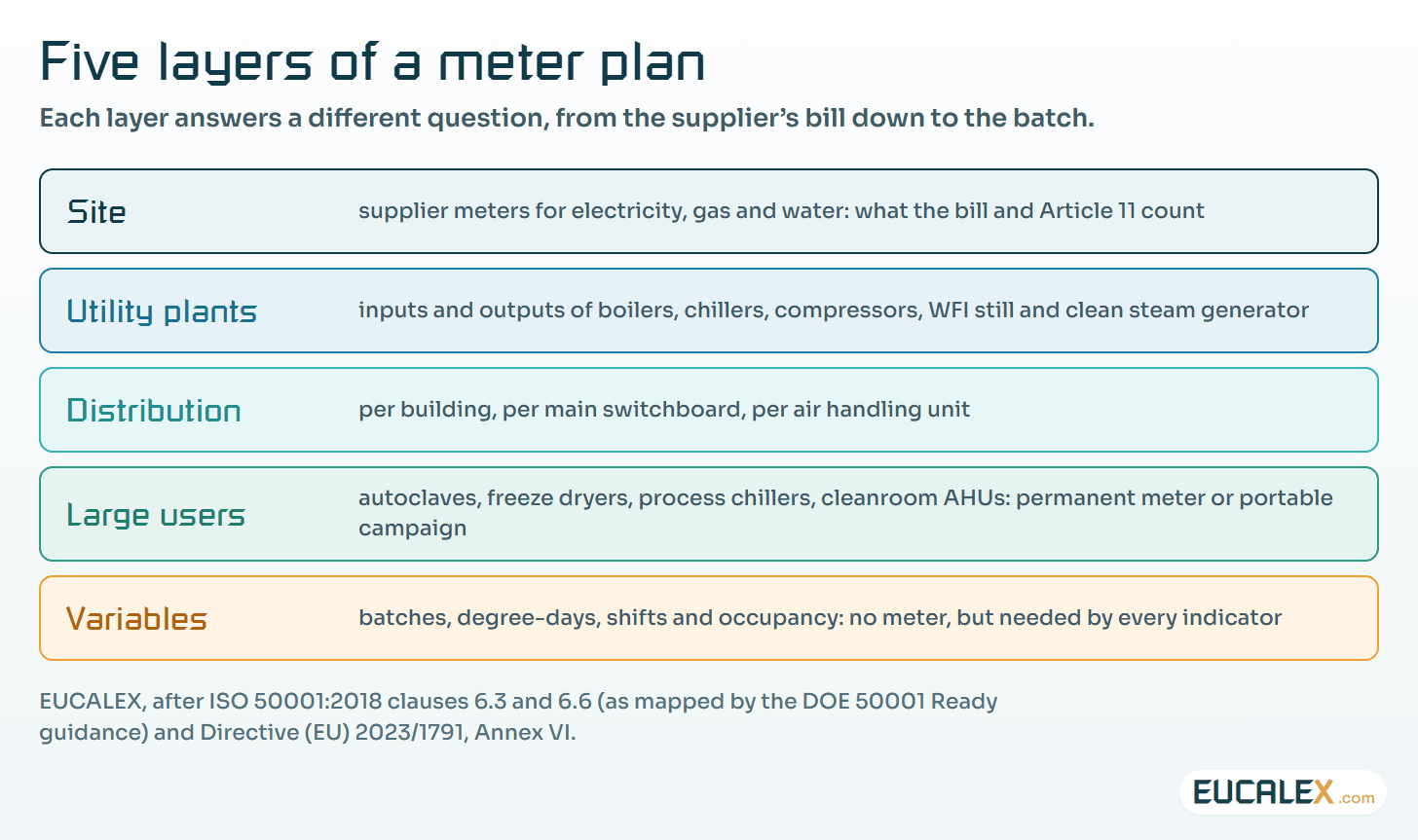
The layer most often missing is the second one. A boiler house with a gas meter on its inlet and nothing on its steam outlet tells you what was bought, not what was made. A compensated steam flow meter on the outlet turns the pair into a boiler efficiency you can trend; a thermal energy meter on chilled water turns the chillers’ electricity into a coefficient of performance.
The fourth layer is where the money is on a pharmaceutical site: the large users. Autoclaves, freeze dryers, the WFI still, process chillers and the air handling units (AHUs) of the cleanrooms. Not every one needs a permanent meter. A portable logger for two representative weeks, documented and repeated after a change, is a legitimate measurement for a use below the 10 % line.
The fifth layer holds no meter at all. Batches started, outside temperature, shifts and occupancy are what the energy figures must be read against, and they usually sit in other systems: the manufacturing execution system, the batch records, the weather station on the roof. Aligning their timestamps with the energy data is half the analytics work, and the reason why the metadata that gives a number its meaning matters as much here as in a batch record.
Indicators that survive a production change
An energy performance indicator (EnPI) that nobody believes after the first product change is worse than none. ISO 50006:2023, the second edition of the guidance on indicators and energy baselines (EnB), and the DOE guidance on clauses 6.4 and 6.5 say the same thing: where relevant variables significantly affect consumption, the indicator is normalised, by an intensity or a regression, and the baseline is adjusted when static factors change.
On a sterile site the trap is the fixed load. Cleanroom ventilation runs whether or not a batch is filled, WFI circulates hot day and night, and the clean steam generator keeps its header warm. Divide the site’s energy by the number of batches and the indicator improves every time production rises, without a single kilowatt-hour saved.
A model with three terms works better: a fixed part, a part per batch, a part per heating or cooling degree-day. Fitted over a year of data, the fixed part shows what the site costs at rest, and that is usually where the cleanroom AHUs and the hot loops sit. Specific consumption is then written with energy over quantity, kWh per kg of steam or kWh per cubic metre of compressed air, never a power over a mass.
When a new filling line arrives, the baseline is adjusted and the reason recorded; the indicator is not quietly rebased. Anyone who has kept control charts for ongoing process verification will recognise the discipline: the chart is only as honest as the rules for moving its centre line.
Electrical meters, and what a power quality study adds
Inside the site, electrical submeters are usually power metering and monitoring devices under IEC 61557-12, consolidated as edition 2.1 in 2021. Read its scope before writing a specification: it excludes billing meters (the IEC 62053 series) and power quality instruments (IEC 62586), and it does not address cyber security. A meter bought for allocation is not a power quality analyser.
A power quality campaign, done with a portable analyser for a few weeks, finds losses that a kWh meter never shows. Harmonic currents from variable speed drives and switch-mode supplies heat cables, transformers and motor windings; the third-order harmonics add up in the neutral of a three-phase supply instead of cancelling. Phase unbalance from single-phase loads heats motors. A low power factor is billed as reactive energy on many industrial tariffs.
There is an irony on pharmaceutical sites. The drives installed to save pump and fan energy are often the largest source of harmonics in the building, so the study belongs in the same project as the drives. The same campaign records the sags and short interruptions that the degraded-mode tests of an operational qualification are meant to cover, which gives the quality team real events to test against.
Pumps: speed first, staging second
In the utility plants we assess, pumps and fans run more hours than anything else, and a good share of their avoidable loss sits across a throttling valve. The DOE and Hydraulic Institute sourcebook (second edition, 2006) is plain: speed adjustment is the most efficient means of controlling pump flow. Flow follows speed, head follows its square and shaft power its cube, so a pump at 80 % speed needs roughly half the power it needs at full speed.
The cube holds only where the system curve passes through zero. Where a large part of the head is static, or is a differential pressure the loop must hold at its far end, the gain shrinks, and the same sourcebook warns that slowing a pump against high static head can bring vibration and the problems of running near shut-off.
Parallel pumps add a second decision: how many to run. Rhinehart and Yebra, simulating five variable speed pumps on a scaled-up solar thermal plant in Automation.com Monthly, August/September 2025, report about 3.4 % less pump power for roughly half the day by running the optimum number, against a reduction of about 90 % in their example of speed control compared with throttling. The order of magnitude is the lesson: speed first, staging second.
We checked the same order on an illustrative chilled-water loop of our own, three identical pumps, computed from the affinity laws and a simple efficiency curve.
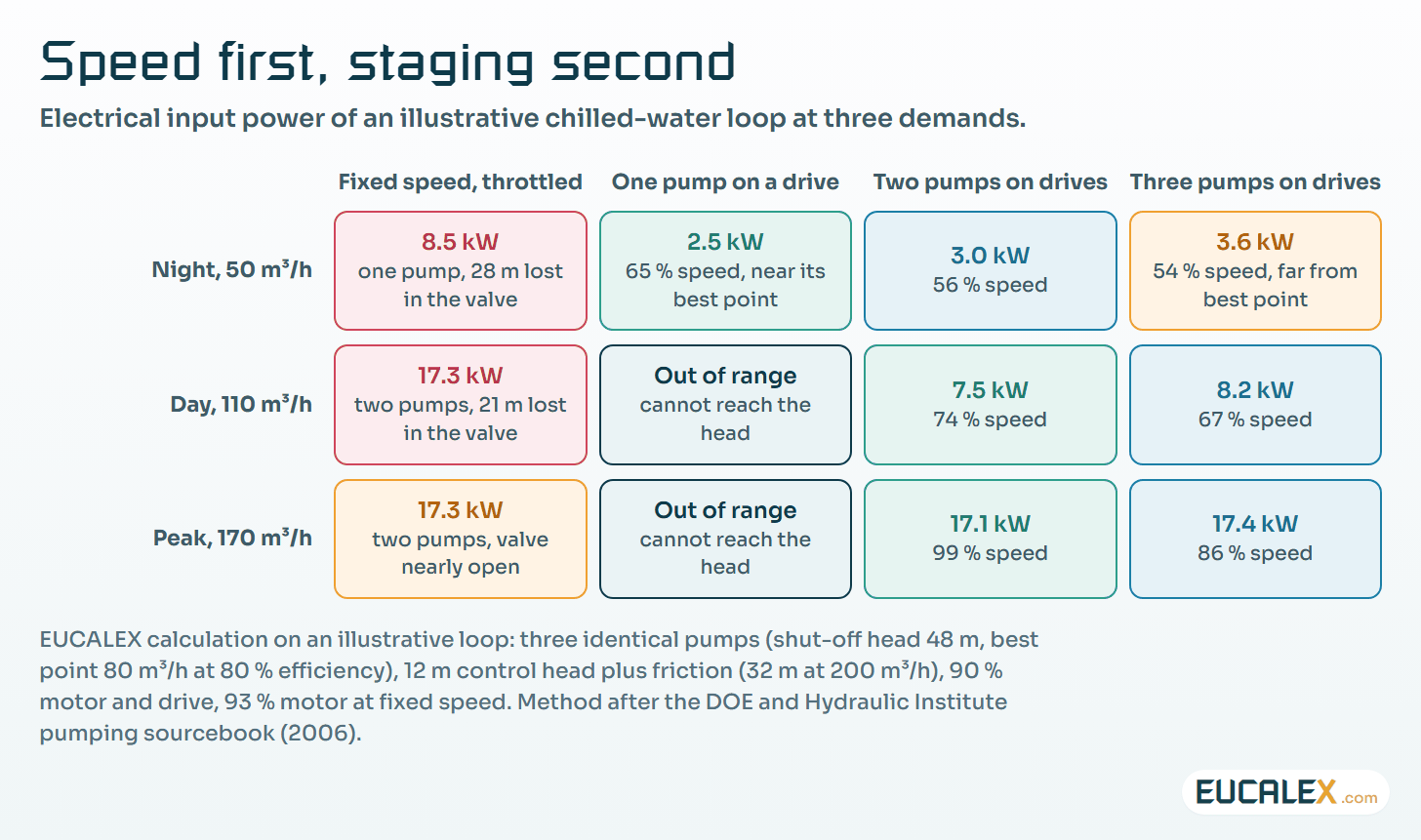
At night the throttled pump burns most of its head in the valve, and one pump on a drive needs less than a third of the power. At peak, the drive brings almost nothing: the valve is nearly open anyway. Staging matters at low flow, where one pump instead of three draws about 30 % less, and fades to a few per cent at peak. So fit the drive and the meter together, and read the savings at part load.
Which savings reopen the qualified state
Here a pharmaceutical site differs from a refinery: the same measure is a work order in one building and a requalification in the next.
EU GMP Annex 1, in operation since 25 August 2023, treats utilities by risk (clause 6.1). For cleanroom ventilation, clause 4.32 lists among the changes to consider for requalification a “change in the design of the cleanroom or of the operational setting parameters of the HVAC system”, the significance being decided through change management. Clause 4.16 requires critical pressure differences to be continuously monitored and alarmed. For water, clause 6.9 asks for turbulent flow in distribution, with the flow rate established during qualification and routinely monitored.
Annex 15, clause 11.4, then asks for quality risk management to evaluate a planned change against product quality, validation, calibration and maintenance, and to plan any requalification. In practice, the GMP weight of a measure follows the system it touches.
| Measure | Typical system | GMP consequence | Evidence before switching on |
|---|---|---|---|
| Clamp-on flow or thermal energy meter, read only | Chilled water, heating water, steam headers | Engineering change, GMP impact assessment | Installation record, calibration certificate, the data path |
| Drive on a secondary pump, pressure setpoint reset | Chilled water feeding AHU coils | Change control with impact assessment | Room temperature and humidity trends inside limits at peak load |
| Compressed air leak programme | Utility air, not in product contact | Maintenance, no GMP impact | Leak survey and repair records |
| Reduced air change rate outside production | Grade C and D cleanrooms | Change to HVAC operating parameters, requalification considered under Annex 1 clause 4.32 | Recovery time, pressure cascade held, particle counts back at rest before use |
| Lower WFI loop speed or temperature | WFI distribution | Major change, requalification of the water system | Turbulent flow at the worst-case point, microbial and endotoxin data, seasonal coverage |
| Heat recovery on a WFI or clean steam condenser | WFI still, clean steam generator | Change control, qualification of the modified part | Leak detection between media, steam quality tests (non-condensable gases, dryness, superheat) |
The table gives the usual starting classification, not a ruling: each site’s risk assessment decides. What it shows is that the measures with the largest savings, at rest on cleanroom ventilation and on hot loops, are precisely those that reopen qualification. A team that finds this out after the business case is approved has planned the wrong year.
The qualification already describes what has to be proven. A setback mode for a grade D corridor is a new operating state, with its acceptance criteria and a test showing that the room returns to its classified state before production restarts: ordinary operational and performance qualification work.
The meters are on the OT network too
A metering project adds dozens of networked devices, often on Modbus TCP or BACnet, frequently with a web page and a default password. They belong in a zone of their own, with one conduit to the energy software, never as a bridge between the building and process networks. Where cabling is the obstacle, wireless transmitters and their gateway suit read-only measurements.
Where to start
- Write the questions first. One page: which figures Article 11, the national text and the auditor will ask for, and which three utilities you suspect of the largest losses. The step is done when the energy manager and the quality lead have both signed it.
- Meter the outputs of the utility plants. Steam, chilled water and compressed air outputs, with clamp-on instruments where possible so that nothing GMP is opened. The step is done when each plant has a monthly efficiency figure with a year of history behind it.
- Sort every candidate saving through change control before the business case. Each measure gets its GMP classification and its evidence list, as in the table above. The step is done when the action plan shows cost, saving and qualification effort on the same line.
Five common mistakes
- Metering everything. Hundreds of points with no question behind them produce dashboards nobody reads. Stop at the 10 % line and use portable campaigns below it.
- An indicator per batch with no fixed term. It rewards production volume, not efficiency, and collapses at the first campaign change.
- Treating the ventilation setback as an energy project. It is a change to a qualified system that happens to save energy; it goes through change control from day one.
- Fitting drives without a power quality study. The harmonics arrive with the savings, and the transformer and neutral conductors pay for them.
- Leaving the meters on a flat network. A read-only energy meter with a default password opens a door into the building network.
The cheapest kilowatt-hour on a sterile site is the one saved on a non-GMP utility. The largest is in the cleanroom at rest, and it comes with a protocol.
References
- Directive (EU) 2023/1791 on energy efficiency (recast), Article 11, Annex VI and Article 36 (Official Journal L 231, 20 September 2023).
- Commission Recommendation (EU) 2024/2002 of 24 July 2024, guidelines for the interpretation of Article 11.
- ISO 50001:2018, energy management systems, and ISO 50006:2023, energy performance indicators and energy baselines.
- IEC 61557-12:2018+AMD1:2021, power metering and monitoring devices.
- EudraLex Volume 4, Annex 1 (2022), clauses 4.16, 4.32, 6.1 and 6.9, and Annex 15 (2015), clause 11.4.
- US DOE and Hydraulic Institute, Improving Pumping System Performance: A Sourcebook for Industry, second edition (2006).
- R. Russell Rhinehart and Luis J. Yebra, Energy Optimization for Parallel Variable Speed Pump Systems, Automation.com Monthly, August/September 2025.
- InTech: Utility Consumption Monitoring for Sustainability, December 2023; Advanced Analytics Drive Sustainability Initiatives, April 2023; Reduce Energy Costs by Measuring Power Quality, August 2021.
Related articles
All articles- When the AI holds the valve: a self-learning controller on a cleanroom HVAC, and where a GMP site draws the lineA vendor has run a cleanroom air-handling system with a self-learning controller and reports a cut in fuel use. What the case shows, why a…
- When the power and the air go away: designing the degraded-mode tests of an OQOperational qualifications test the normal path well and the failure path badly. What to observe when electrical power and compressed air are lost…
- Which measurements can go wireless? WirelessHART, ISA100 and the gateway you must secureWireless transmitters are mature. The real decision is which readings may depend on a radio, and how the gateway, the join keys and the GMP record…
EUCALEX
Have a project or a technical challenge?
Contact us: we will be pleased to discuss it with you, with no commitment.
Discuss your project with usStay informed
Receive new EUCALEX articles and technical insights by email.