
OEE on a GMP packaging line: why the number is low, and which losses are really yours to remove
Picture the monthly performance review on a site with two blister lines: same machine builder, same formats, bought in the same year. On the slide, one line sits in the low forties and the other in the low sixties. The plant manager asks the obvious question, and the team of the better line gets a quiet nod. Two weeks later an engineer sits down with both shift logs and finds the answer. The second line books line clearance, the format change and the start-of-batch checks as planned time. The first line counts every minute of them as lost availability. Nobody cheated. Nobody had agreed what the clock was.
That is the usual first lesson of overall equipment effectiveness (OEE) in pharmaceutical packaging. The arithmetic is simple; the definitions carry the whole result. A GMP line spends much of its day on work a food line never does, and where those minutes land decides whether the number means anything.
Three ratios and a great deal of judgement
OEE multiplies three ratios. Availability is the share of planned production time in which the line actually ran. Performance compares what it produced in that run time with what it would have produced at its ideal rate. Quality is the share of that output that was good. The product is the share of planned time that turned into good packs at full speed.
The idea comes from total productive maintenance (TPM), the Japanese approach to equipment care that Seiichi Nakajima brought to English-speaking engineers with Introduction to TPM in 1988. The TPM literature sorts the losses into six families, two behind each ratio, and that is still the most useful way to walk a line with a notepad. ISO later gave the indicator a formal home: ISO 22400-2, on key performance indicators for manufacturing operations management, describes its KPIs by formula, time and quantity elements and unit. The edition in force is still the one of 2014, amended in 2017 to add energy indicators; a second edition was approved for registration as a final draft in September 2024 and ISO still lists it as under development.
What neither TPM nor ISO gives you is a target. Two trade features behind this article — Kevin Welsch in AUTOMATION, May 2023, and Fiona Guinee in InTech, December 2023, both listed below — mention 85 per cent, one as the level at which leading companies run, the other as a “world-class” label it warns against chasing. It is a convention from discrete manufacturing. No standard sets it, we found no study that measures it for pharmaceutical packaging, and no GMP text asks for an OEE at all. A line running short campaigns of small batches can be well managed at a figure that would worry a beverage plant.
| Loss | Ratio | What it looks like on the line | Who removes it |
|---|---|---|---|
| Breakdowns | Availability | A servo fault on the cartoner, a sealing heater that fails, a labeller that will not restart | Maintenance and engineering |
| Set-up and adjustment | Availability | Format change, line clearance, start-of-batch checks, first-off adjustments | Production, with QA owning the GMP steps |
| Minor stops | Performance | Blisters jamming at the transfer, an empty carton magazine, a leaflet not picked | Engineering and operators, format by format |
| Reduced speed | Performance | The line run below its rated speed “because it rejects less that way” | Engineering, then a recorded decision |
| Process defects | Quality | Rejects from vision, weight or code checks; cartons reworked | The process owner, never by loosening the check |
| Start-up losses | Quality | Units used for set-up and challenge tests at batch start | Planned with QA; reduced only by changing the method |
The GMP steps that sit inside the clock
Generic OEE advice treats set-up as waste to be squeezed out. On a GMP line, a good part of it is required, and inspectors read the records it produces.
- Line clearance. EU GMP Chapter 5 (5.50) asks that, before packaging starts, the work area, packaging lines, printing machines and other equipment be clean and free of any product, material or document from the previous operation, checked against a checklist. In the US, 21 CFR 211.130(e) requires the packaging and labelling facilities to be inspected immediately before use, with the result documented in the batch production record.
- Device checks. Chapter 5 (5.57) asks for checks that electronic code readers, label counters and similar devices are working correctly. In practice that means challenge tests at batch start and after interventions, which consume deliberately faulty samples and line time.
- Reconciliation. Chapter 5 (5.61) requires any significant or unusual discrepancy between bulk product, printed packaging materials and units produced to be investigated and accounted for before release. 21 CFR 211.125(c) asks for labelling issued, used and returned to be reconciled, and 211.192 for any unexplained discrepancy to be thoroughly investigated.
- Waiting for people. Clearance signatures, a first-off sample on its way to the lab, a packaging material not yet released. No regulation describes these, yet on most lines they take more time than the machine does.
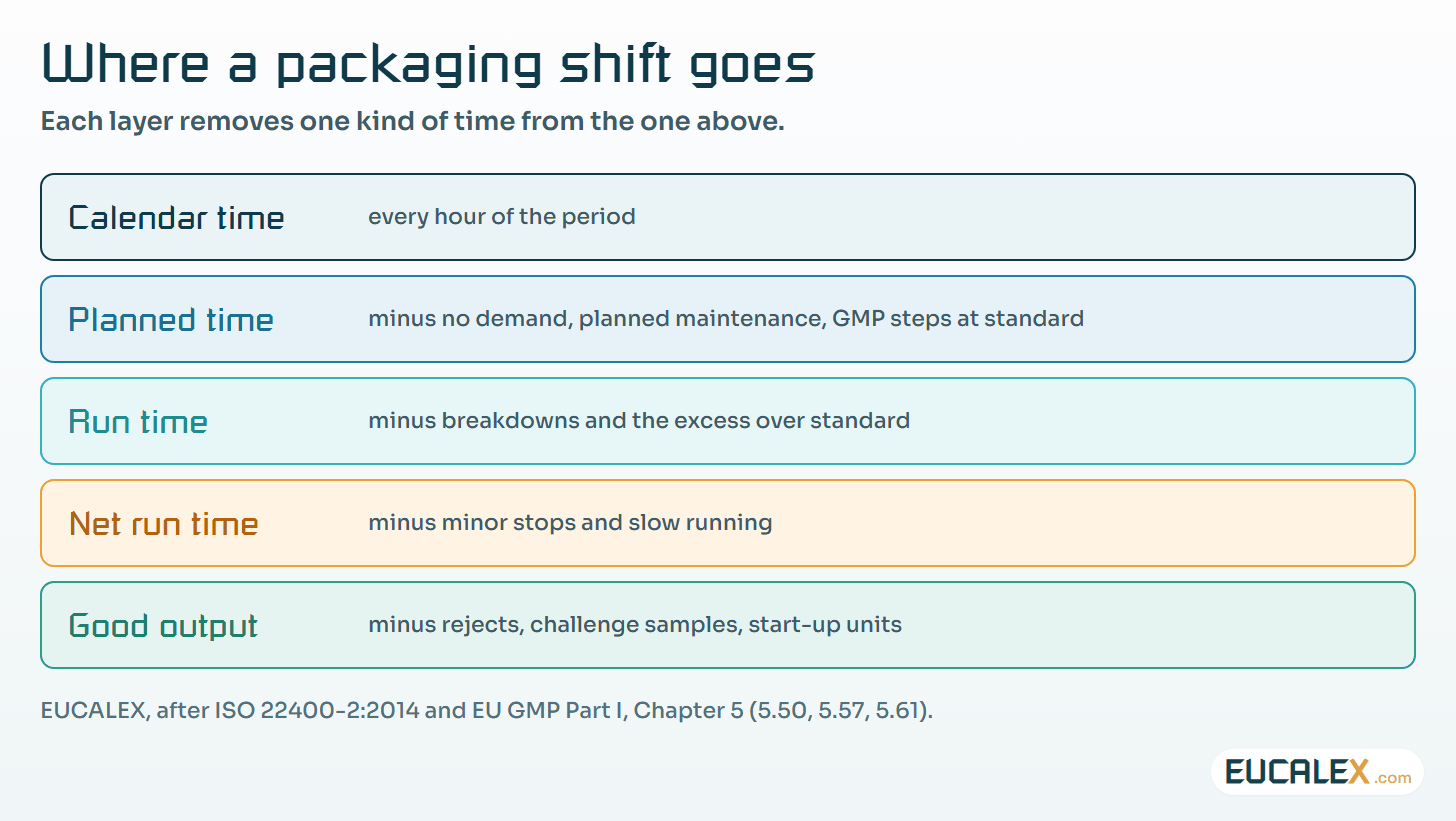
None of the first three is optional, so the temptation is to book them all as planned time. The number improves at once, and the place where most packaging capacity disappears drops out of view. Counting every minute of clearance as lost availability does the opposite: the line looks broken, and people are pushed to hurry the very steps the batch record depends on.
Split the standard from the excess
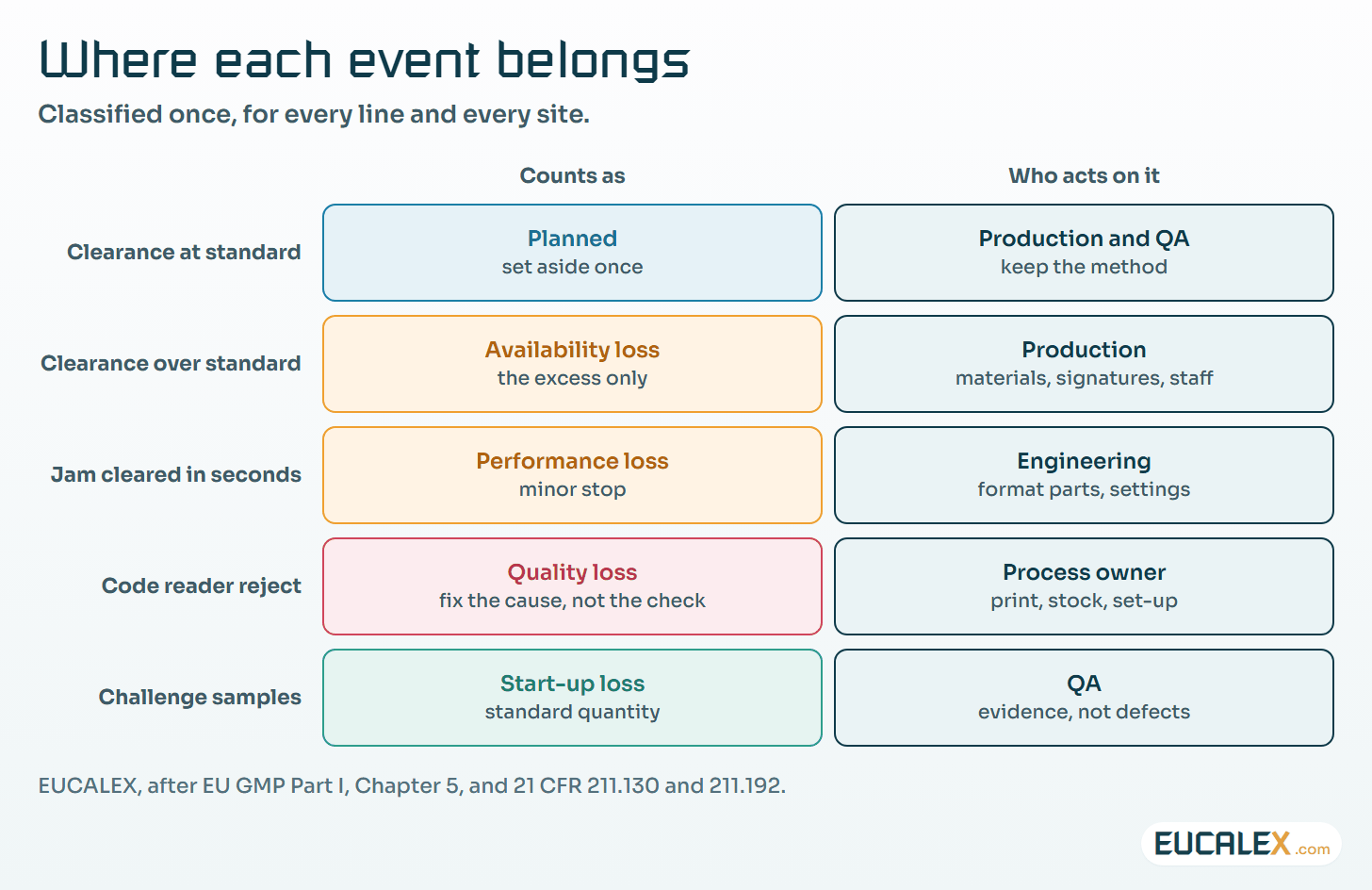
The answer that works is to give each GMP step a standard time and count only the excess as loss. Guinee’s InTech feature describes an unnamed pharmaceutical company doing exactly this with changeovers: it measured the lowest repeatable time for each stage, booked that part as planned and treated anything above it as unplanned downtime to investigate. The example is the author’s and cannot be checked, but the method is sound and needs no particular software.
On a blister line the usual pattern is that the standard part of a format change is fairly stable, and the excess comes from the same few places every week. The format parts trolley is incomplete. The foil reel has not been issued by the warehouse. The clearance checklist waits for a second signature because the QA operator is on another line. The first-off sample waits for the lab. Not one of these is a machine problem, and each has an owner who never sees the OEE slide.
The standard time comes from watching the people who do the job, and is reviewed whenever the procedure changes: if the clearance checklist gains three items after a mix-up, its standard grows with it. Cutting the standard without changing the method only moves minutes between columns.
A reject is not scrap
Quality is where the generic formula misleads a GMP line most. A carton rejected by the code reader is a quality loss, and it should be counted. But a falling quality ratio can also mean that a check has started doing its job. A reader just requalified, a tighter print contrast limit after a complaint, a new verification of serialised codes: each takes more units out of the good count, and each protects a patient. Challenge samples fed in to prove that the reject station rejects are not defects either. They are the cost of evidence, and they belong in start-up loss at a standard quantity.
The dangerous move goes the other way. When OEE pressure reaches a line with a high reject rate, someone eventually suggests widening a vision tolerance, or slowing the line so the reader “sees better”, without a change control. A reject is a symptom to trace back to its cause: the print head, the foil, the carton stock, the set-up. Proving that a reject station really rejects is the subject of our article on challenge testing sensors, code readers and metal detectors, and that test must never become the variable an OEE project adjusts.
The count that has to agree with the batch record
This is where OEE meets data integrity, and few projects see it coming. The OEE system counts units from signals on the line, typically a good count after the last reject station. The batch record counts them too, in the reconciliation at the end of the packaging order. Sooner or later a QA reviewer, or an inspector, puts the two side by side.
If they differ and nobody can say why, the site has two counts of the same batch, and one of them is in the GMP record. A dashboard showing a different good count does not trigger 5.61 or 211.192 by itself, but it invites exactly the question those clauses are about.
So decide early which system holds the record. Usually the OEE tool stays outside GMP scope and its counts are indicative. Then write that down, make sure nobody copies its figures into the batch record, and explain in the procedure why the two numbers can differ: a different counting point, challenge samples, units taken for in-process control. If instead the OEE counts feed the reconciliation, the system is used as part of a GMP-regulated activity and EU GMP Annex 11 applies, with validation, built-in checks on data exchanged with other systems and an audit trail to match. Both choices can be defended. Drifting from one to the other cannot.
Micro-stops: what the clipboard never sees
Both features insist that manual capture misses short stops, and on packaging lines that is where performance goes. An operator clears a blister jam in ten seconds, many times a shift, and writes nothing down. The paper log shows a good day; the counters show a line well below its rated speed.
Most packaging machines already hold a running state, a fault word and counters in their controller, and a gateway or the line’s MES can read them without touching the qualified logic. The hard part is the reason. A stop code tells you the cartoner stopped on “carton not present”. It does not tell you that the magazine was filled with stock from a new supplier whose flaps open stiffly. That comes from operators, which is why the reason tree must be short, owned by production and written in the line’s own words. Ten reasons used every day beat sixty that nobody picks.
Correlating stops with batch, material and maintenance data is then a question of access to data more than of OEE.
When the number becomes the target
The InTech feature names two ways to raise OEE without making a single extra pack: adjusting the ideal production rate, and reclassifying stops as planned events. A GMP line has three more, and they are worse because they touch compliance: rushing a line clearance, skipping the restart challenge after a jam, and closing a reconciliation gap with a standard comment. None of them shows on the OEE trend; all of them show up eventually in a deviation or an inspection report. It is the slow drift we described in when the workaround becomes normal.
Keep OEE as a tool for the line, not a score for individuals. Show the shift its own losses as they happen, show engineering the loss tree by format, and give management the trend with the definitions printed on the same page.
Where to start
- Write the clock before the dashboard. One page: what counts as planned time, how each GMP step is booked, the ideal rate per format. Signed by production, engineering and QA.
- Measure the standard time of each GMP step. The lowest repeatable time, observed on the line, reviewed whenever the procedure changes.
- Take states and counts from the machine. Running, stopped, fault, units in, good units out, read without changing qualified code.
- Build a short reason tree with the operators. Their words, a handful of reasons, reviewed after a month of real use.
- Reconcile a few batches by hand. Put the OEE good count next to the batch record reconciliation and explain every difference before anyone discusses a trend.
Five common mistakes
- Comparing lines without comparing definitions. Two clocks, two meaningless numbers.
- Taking 85 per cent as a target. It is a convention from other industries, not a requirement or a pharmaceutical benchmark.
- Treating every reject as waste. Some rejects are the system working; challenge samples are evidence.
- Letting the ideal rate drift. Set it per format from the speed the line was qualified at, not from the nameplate or last month’s average.
- Two counts and no owner. If the OEE count and the batch record disagree, someone must already know which one is the record, and why.
An honest OEE on a GMP line is rarely a high one. It is one where every minute and every pack can be explained, and where the explanation never asks anyone to cut a corner the batch record depends on.
References
- European Commission, EudraLex Volume 4, EU GMP Part I, Chapter 5: Production, in operation since 1 March 2015, paragraphs 5.49 to 5.62 (packaging operations).
- European Commission, EudraLex Volume 4, Annex 11: Computerised Systems, revision of January 2011.
- US FDA, 21 CFR Part 211, Current Good Manufacturing Practice for Finished Pharmaceuticals, sections 211.125, 211.130 and 211.192.
- ISO, ISO 22400-2:2014, Key performance indicators (KPIs) for manufacturing operations management, Part 2: Definitions and descriptions, with Amendment 1 (2017).
- Kevin Welsch, Using OEE Data to Improve Manufacturing Operations, AUTOMATION 2023 Volume 3, automation.com, May 2023.
- Fiona Guinee, How Advanced Analytics Enables OEE Improvement, InTech, December 2023 (ISA).
Related articles
All articles- Challenge testing: proving that sensors, code readers and metal detectors actually rejectA detector that has failed looks exactly like a detector with nothing to detect. The only proof is to make it fail on purpose: which defects to…
- Breaking down data silos: why data integration decides whether digital transformation worksERP, MES, LIMS, historian and quality systems each hold part of the truth about a batch. The five things data integration must deliver on an…
- When the workaround becomes normal: drift, “operator error” and CAPAs that change nothing on a GMP siteNobody decides to accept a bypassed interlock or a deviation that keeps coming back; teams drift there one reasonable step at a time. How it shows…
EUCALEX
Have a project or a technical challenge?
Contact us: we will be pleased to discuss it with you, with no commitment.
Discuss your project with usStay informed
Receive new EUCALEX articles and technical insights by email.