
Building management systems: what a BMS is for, the buses underneath, and the supervision on top
On most industrial sites the building is the second process. It holds the temperature, the pressure cascade and the air changes the product depends on, and it carries a large share of the site’s energy bill. It also runs on its own controllers, its own buses and its own software, usually bought by a different department, on a different budget line, from the people who buy the automation on the production line.
That separation used to be harmless. It is not any more. Since the recast of the European energy performance of buildings directive, a building automation and control system on a large non-residential building is a requirement with a date attached, no longer good practice. And the moment the building system starts producing records that the quality department relies on, it stops being facilities management and becomes a system somebody has to qualify.
This article is the high-level map: what a building management system is, what it is really for, the buses you will find in a plant room, and the supervision software on top, including the products you will be quoted by name.
What a BMS is, in three levels
The vocabulary is a small obstacle in itself. In English the system is a building management system (BMS) or a building automation system (BAS). The European directives and standards call it a building automation and control system (BACS). In French it is the GTB (gestion technique de bâtiment), with GTC (gestion technique centralisée) usually meaning a narrower, single-discipline version. All of them describe the same three-level architecture, and an automation engineer already knows it.
- Field level. Sensors, valve and damper actuators, variable-speed drives, light ballasts, meters. Mostly dumb, mostly cheap, and the level where a bad specification costs the most over fifteen years.
- Automation level. Programmable controllers (plant controllers for air handling units and chillers, room controllers for terminal units) running the loops and sequences whether or not anyone is watching. If the supervision dies, this level keeps the building alive.
- Management level. Supervision, trending, alarms, schedules, energy dashboards, reporting. This is what people mean when they say "the GTB", and it gets most of the space below.
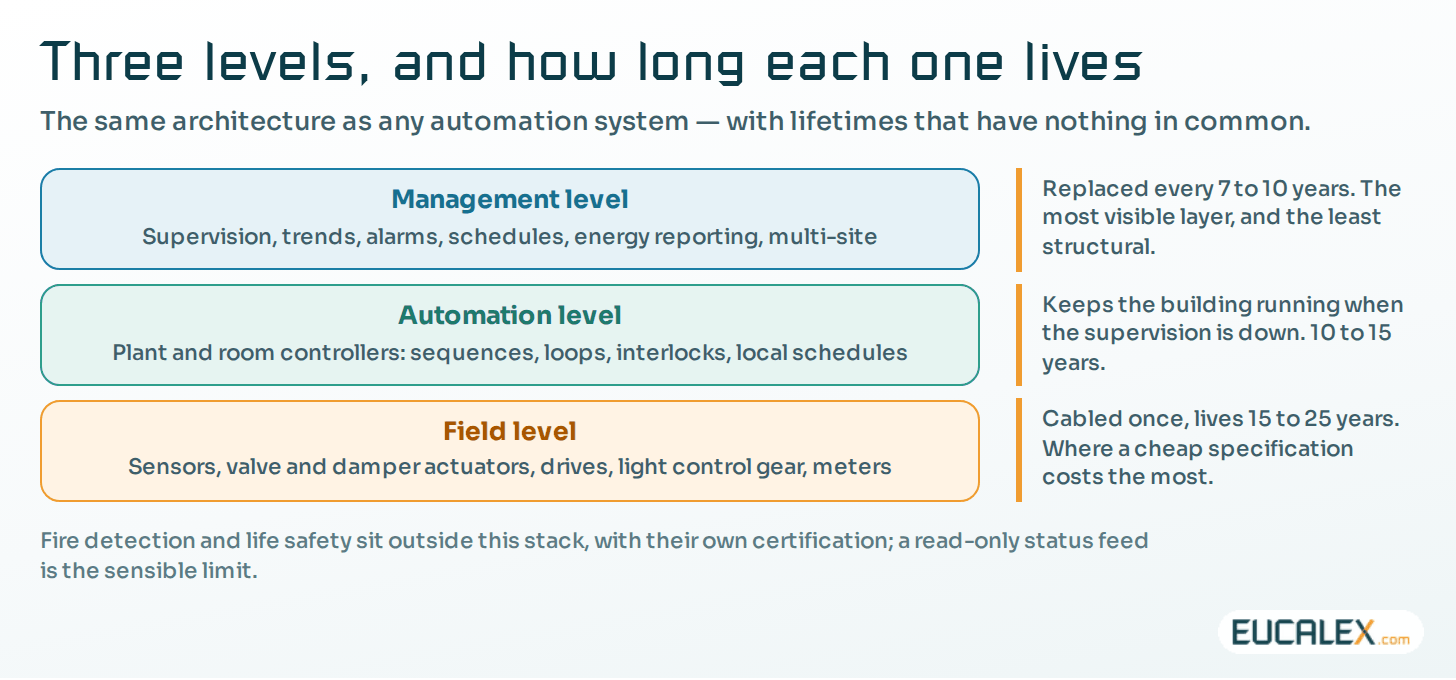
What belongs inside the BMS is a design decision. Heating, ventilation and air conditioning, always. Lighting and blinds, usually. Metering almost always. Lifts, access control and video sometimes, through gateways. Fire detection and life safety, essentially never: those are certified systems with their own regulatory regime, and integrating them beyond a read-only status feed creates a problem you do not want to own.
What it is actually for
Four answers, in the order the money usually turns up.
- Conditions. The building holds what the process needs: temperature, humidity, pressure differentials between rooms, filtered air at the right number of changes per hour. On a regulated site these are part of the product’s environment rather than comfort settings, and the tests that prove them belong to qualification, including the ones that show what happens when the power or the compressed air goes; see designing the degraded-mode tests of an OQ.
- Energy. On most existing buildings a building automation and control system is the cheapest energy measure per euro, because it changes how existing plant is run instead of replacing it. The European standard that quantifies this, EN ISO 52120-1:2022, sorts systems into four BAC efficiency classes (A, B, C and D) with C as the reference. Manufacturers publish attractive figures for moving from C to A; treat them as indicative. A 2026 peer-reviewed study of the standard’s fixed-factor method found real savings for emission control ranging from 19 % to 71 % on heating and 1 % to 58 % on cooling depending on the building, and concluded that one fixed factor cannot represent that spread.
- Availability. A properly alarmed BMS tells you that a filter is loading, a valve is hunting or a pump has failed over, before the room drifts. Same argument as for any other instrument: a signal nobody wired is a signal nobody has, as with the UPS that was never told the PLC existed.
- Evidence. Trends, alarm logs and schedules are records. As soon as a quality decision depends on one of them, the metadata around the number matters as much as the number; see the part of the record that makes the number mean something.
The buses you will meet in a plant room
A building rarely runs on one protocol. A realistic large site has BACnet between the plant controllers and the supervision, Modbus to the chillers and the meters whose manufacturer would not open anything else, DALI inside the lighting, KNX in the offices and meeting rooms, sometimes LonWorks left over from the previous generation, and a handful of battery-free radio switches. That is normal. Discovering it during commissioning is not.
| Protocol | Standardised as | Designed for | Typical medium |
|---|---|---|---|
| BACnet | ANSI/ASHRAE 135 and ISO 16484-5 | Plant and supervision: the language between controllers and the head-end | BACnet/IP over UDP port 47808, or MS/TP over RS-485 |
| KNX | ISO/IEC 14543-3, EN 50090, EN 13321 | Room functions: lighting, blinds, terminal units, switches | Twisted pair, radio, powerline, IP |
| LonWorks | ISO/IEC 14908, ANSI/CTA-709 | Device-to-device control, historically HVAC | FT-10 free topology twisted pair, 78.125 kbit/s |
| DALI | IEC 62386 | Inside the lighting: dimming, groups, scenes, lamp fault feedback | Two wires, polarity free, 1200 bit/s |
| EnOcean | ISO/IEC 14543-3-10 and -3-11 | Battery-free switches and sensors where cabling is impossible | Radio, 868 MHz in Europe, 125 kbit/s |
| Modbus / M-Bus | Modbus Organization specification; EN 13757 for M-Bus | Reading what is closed: chillers, meters, packaged plant | RS-485 or TCP port 502; two-wire bus for M-Bus |
Three points the table does not show.
BACnet is the integration language, and it keeps moving. The current edition is ANSI/ASHRAE 135-2024, protocol revision 31. It models everything as devices and objects (more than sixty standard object types), and it is the only one of these protocols with a serious, public certification programme: BACnet Testing Laboratories, run by BACnet International, tests products against device profiles and publishes the result. That matters when you write a specification, because B-AWS (advanced operator workstation), B-OWS (operator workstation) and B-BC (building controller) are claims you can check.
KNX is bigger than its reputation. A line carries up to 256 devices across four segments, fifteen lines make an area and fifteen areas make a network, so one installation can run to tens of thousands of devices. All of it is engineered with one manufacturer-independent tool, ETS, which is what keeps a KNX installation maintainable when the original integrator has gone.
DALI, on the other hand, is a lighting bus and nothing more. Sixty-four addresses for control gear on a line, sixteen groups, sixteen scenes, a total supply current of 250 mA and 300 m between the two furthest devices. It reports lamp and driver faults, which is the real reason to use it, and it reaches the rest of the building through a gateway, never directly.
The supervision: four families, and the names you will be quoted
The confusion is worst here, because four quite different kinds of product all get called "the supervision".
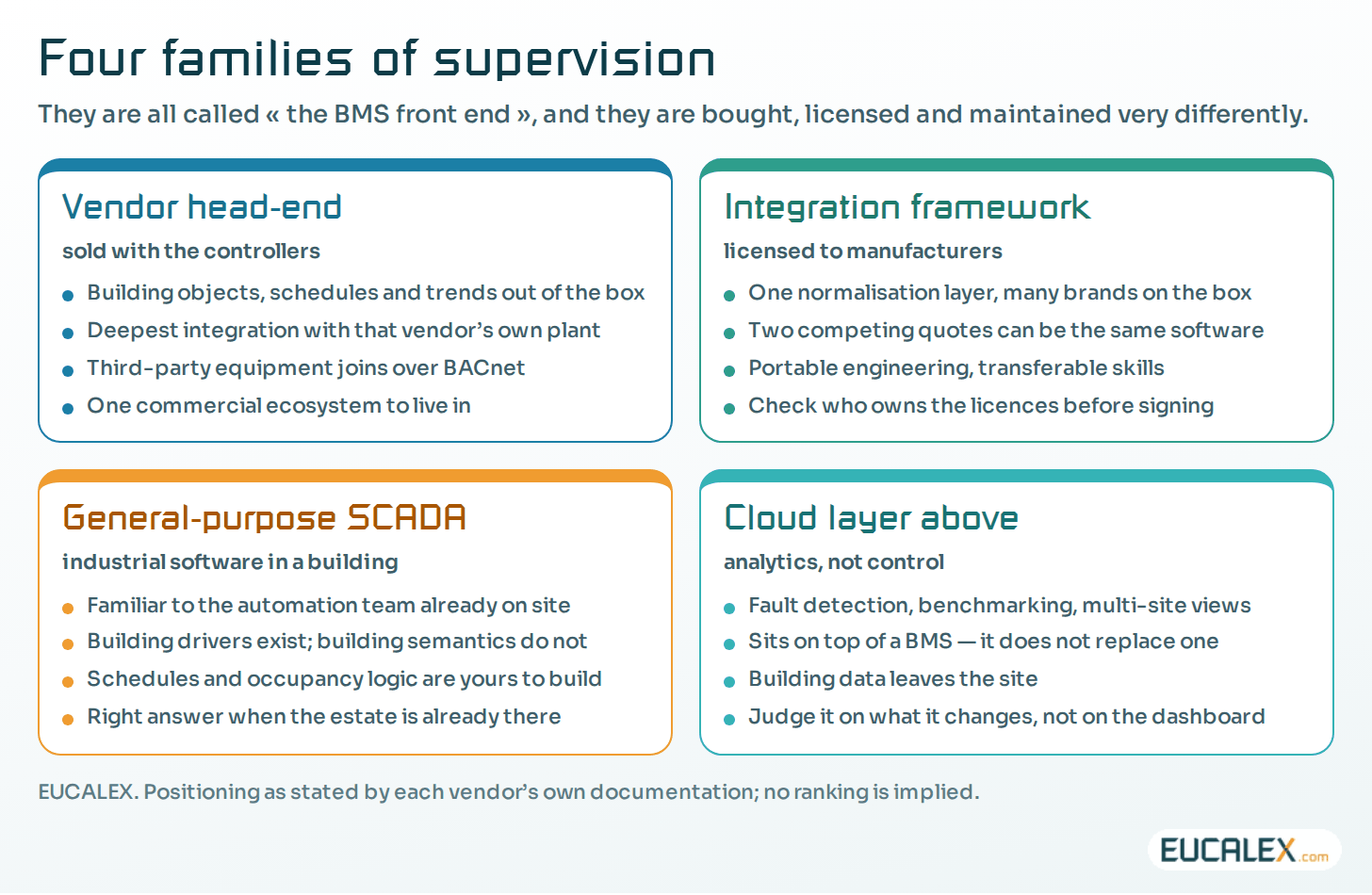
| Family | Examples | What it is | Where it hurts |
|---|---|---|---|
| Vendor head-end | Siemens Desigo CC · Johnson Controls Metasys · Schneider EcoStruxure Building Operation · Sauter Vision Center · Delta Controls enteliWEB | The management level sold with the manufacturer’s own controllers, deeply integrated with them | Third-party plant is integrated over BACnet, but you stay inside one commercial ecosystem |
| Integration framework | Tridium Niagara Framework, rebranded by its partners: Distech EC-Net Facilities, Honeywell WEBs-N4, Trend IQVISION and others | A vendor-neutral normalisation layer licensed to manufacturers, who sell it under their own name | Powerful and portable, but the licensing and the engineering skills follow the brand you bought |
| General-purpose SCADA | PcVue (ARC Informatique) · Panorama (Codra) · SIMATIC WinCC OA · Ignition · AVEVA Plant SCADA | Industrial supervision software with building drivers, familiar to an automation team | You get an industrial toolbox, not building objects: schedules, occupancy and BACnet semantics are yours to build |
| Cloud layer above | Johnson Controls OpenBlue · Honeywell Forge for Buildings · Schneider EcoStruxure Building Advisor · Siemens Building X | Analytics, fault detection and multi-site reporting on top of an existing BMS | It does not replace the BMS, and it takes your building data off site |
A few facts worth having before the first meeting.
“AVEVA does GTB” needs qualifying. AVEVA Plant SCADA (the former Citect) ships more than 150 native drivers including BACnet, and AVEVA positions it for industrial process and infrastructure rather than as a building management system. On an industrial site with an existing AVEVA estate it can still be the right answer, because the operators already know it. Just do not expect building objects out of the box.
PcVue is the French building specialist of that family, and the detail that decides projects is in its documentation: the BACnet client is listed as B-AWS and B-OWS, and it speaks BACnet/IP only, so MS/TP devices reach it through a router. Panorama, from Codra, plays in the same space and announced BACnet certification for its 2022 release.
Niagara is not a product you compare with Desigo CC. It is a framework with more than a million deployed instances, sold through manufacturers who rebrand it. Two competing quotes can be the same software with different logos, different licence terms and different engineering partners. Whether that is an opportunity or a trap depends on whether you noticed.
Product generations also move faster than reputations. Trend’s 963 supervisor reached end of support on 31 December 2024 and was replaced by a Niagara-based product. Metasys is at release 16, Desigo CC at version 9. Naming a version from a colleague’s last project in the specification is how a site ends up buying something already out of support.
And nobody owns this market. The market is large and concentrated at the top, with the same handful of groups named every time, yet an independent analyst assessing 87 platform providers concluded in 2025 that no single vendor offers a comprehensive solution. Design for integration. A single supplier to call is comfortable until that supplier changes its product line.
The part that is no longer optional
The regulatory picture changed while most sites were looking elsewhere, and the dates are close.
- Europe. The 2018 amendment to the energy performance of buildings directive introduced building automation and control systems for non-residential buildings above 290 kW of heating or air conditioning. The 2024 recast, Directive (EU) 2024/1275, carries the obligation in Article 13: above 290 kW by 31 December 2024, and a new, lower threshold of 70 kW by 31 December 2029. The system must monitor and analyse energy use, benchmark efficiency and detect losses, communicate with connected technical building systems across manufacturers, and, by 29 May 2026, monitor indoor environmental quality. Automatic lighting controls come with their own dates, 2027 and 2029.
- France. The décret BACS (n° 2020-887, amended in 2023 and again in December 2025) sets 1 January 2025 for existing buildings above 290 kW, and 1 January 2030 for those above 70 kW, a date moved back from 2027. The requirement level is the part most often misquoted: the ministry’s own guide states that a system in class C of NF EN ISO 52120-1 is deemed to meet the regulation. Class C is the floor. The European Commission’s guidance reads the directive’s functional requirements as corresponding to class B.
For an industrial site the consequence is plain. If the heating or cooling plant is above the threshold, the BACS is a compliance item with a date, and the cheapest way to fail it is to install one that nobody configures, alarms or reads.
Eight lines for the specification
- Name the device profiles, not the brand. Require BTL-listed products and state the profile: B-BC for plant controllers, B-AWS for the workstation. Ask for the listing entry, not a brochure.
- Require the engineering data in a format you can open. Point lists, BACnet object identifiers and names, KNX group addresses, the ETS project file. Without them the next contractor starts from zero and charges you for it.
- State the BACS class you are buying under NF EN ISO 52120-1, and make the integrator demonstrate the functions that justify it.
- Say where MS/TP stops. Every serial segment is a router, a commissioning cost and a future fault. Decide the IP boundary on the drawing, not on site.
- Specify the security transport. BACnet Secure Connect (added to the standard in 2019 and now part of ANSI/ASHRAE 135-2024) carries BACnet over authenticated, TLS-protected connections. KNX Data Secure and KNX IP Secure do the equivalent for KNX. Ask which one the offer implements, and on which devices.
- Put the BMS in your network architecture, explicitly. It is an OT system on an IT-looking network and needs its zone, its conduits and its own account management like any other; see zones and conduits: start from the risk and which network does each industrial site need.
- Require the alarm philosophy as a deliverable, not just the alarm list. Who is called, at what hour, with what priority, and what happens when nobody answers.
- Buy the exit. Licence terms, engineering tool access, who holds the source of the control programs, and what happens if you change integrator. On a framework-based offer, ask who owns the licences.
Five mistakes we keep seeing
- Buying supervision before deciding the architecture. The head-end is the visible part and should be the last decision made.
- Treating the BMS as a building service. It runs the conditions the process needs, so it belongs in the same conversation as the rest of the plant.
- Integrating fire detection into the BMS. A read-only status feed is a service. Anything beyond that moves a certified system into an uncertified one.
- Leaving default credentials and flat networks because the BMS was installed by a contractor who has since left. An old air gap does not protect it, for the same reason it decays everywhere else.
- Commissioning the points and not the sequences. Every point reads correctly and the building still fights itself, because nobody tested the changeover between heating and cooling, or what happens when the power comes back.
References
- Directive (EU) 2024/1275 on the energy performance of buildings (recast), Article 13. eur-lex.europa.eu
- Décret n° 2020-887 du 20 juillet 2020 (décret BACS), amended by décret n° 2023-259 and décret n° 2025-1343; application guide, January 2026. rt-re-batiment.developpement-durable.gouv.fr
- ISO 52120-1:2021 / EN ISO 52120-1:2022, BAC efficiency classes. iso.org
- ANSI/ASHRAE Standard 135-2024, BACnet: A Data Communication Protocol for Building Automation and Control Networks, and ISO 16484-5. bacnet.org
- Vandenbogaerde, Audenaert and Verbeke, Energy Efficiency 19:7 (2026), on the limits of the fixed-factor method. link.springer.com
Related articles
All articles- Essential, Premium or Platinum: which network does each industrial site need?Three network architecture levels for industrial sites: what each one doubles, what it survives, how it is secured, what it costs, and when to…
- The UPS is installed. Nobody told the PLC it was about to lose power.On a lot of sites (including brand-new ones) the UPS is present, wired and green. And it still does not do half of what it was bought for.
- Siemens networks from PPI to PROFINET: what each one is, where it still runs, and how to keep it workingAn older plant often runs four Siemens networks at once: a PPI or MPI programming link, PROFIBUS to drives and remote I/O, a Modbus device behind a…
EUCALEX
Have a project or a technical challenge?
Contact us: we will be pleased to discuss it with you, with no commitment.
Discuss your project with usStay informed
Receive new EUCALEX articles and technical insights by email.